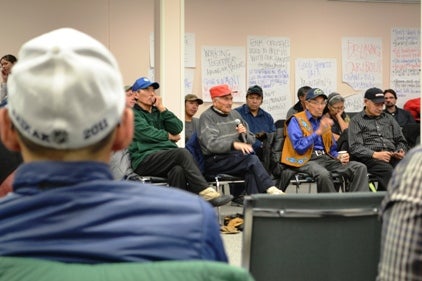
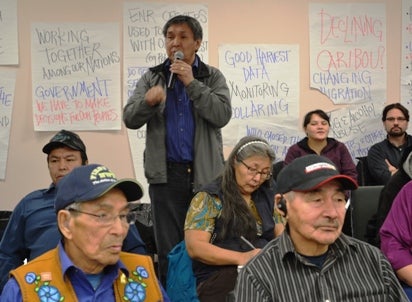
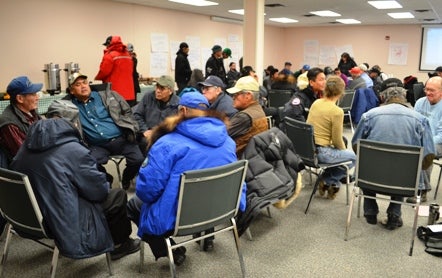
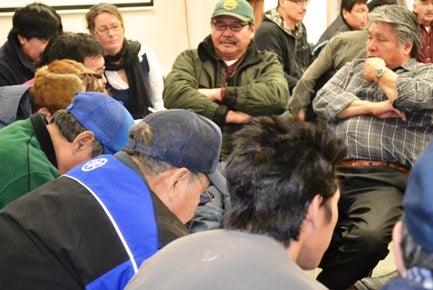
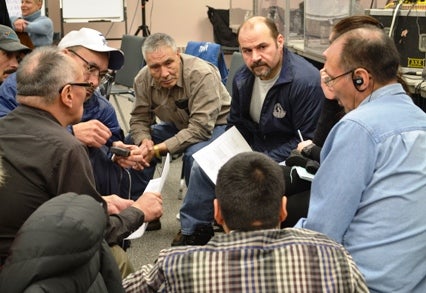
The WRRB and Tłı̨chǫ Government co-hosted a gathering January 29-31, 2013 that brought together harvesters of the Bathurst caribou herd from the NWT, Nunavut and Saskatchewan—the first gathering of its kind for the Bathurst Caribou. Elders, harvesters and youth were invited to share their knowledge, experiences and ideas for managing the herd.
The goal of the Gathering was to bring together representatives from the Aboriginal peoples who have traditionally harvested the Bathurst Caribou to learn from one another, identify common goals, and together, offer recommendations to guide short and long-term planning for the herd. Delegates included harvesters from the Tłı̨chǫ, Sahtu, Dehcho, Metis, and Akaitcho regions in the NWT, and from western Nunavut and northern Saskatchewan. Management Boards and governments with jurisdiction within the herd’s range were also in attendance. Delegates initially met in Behchokǫ̀ , until cold weather and a power outage resulted in a change of venue to the Tree of Peace Friendship Centre in Yellowknife for the second and third day of the Gathering.
Taking a grassroots approach, the Gathering aimed to promote community stewardship of the Bathurst Caribou –and to guide wildlife management authorities, including the WRRB, in management planning for the herd. In the past, the Bathurst herd was one of the largest herds of barren-ground caribou in Canada, but in recent years, it has seen declining numbers. The latest population estimate (2012) indicates that the population may be beginning to recover but its numbers remain low.
One delegate spoke of how with the loss of caribou, knowledge about caribou is also in danger of being lost.
What can we learn from the past to adapt to management practices today? What can we learn from each other? What should our priorities be for the short term and for the long term? Discussions focused on these questions as harvesters shared their ideas for moving forward with management planning for the herd.
Delegates spoke of the importance of learning as much as we can about the caribou –including their behaviours, movements, factors affecting their health, and possible reasons for decline. How is human activity, including development, affecting the herds, for example? What are the effects of climate change? It will be important to look to both science and traditional knowledge for answers as the two, as one participant said, “go hand in hand”.
Participants suggested that a way to gather useful information is learning from other jurisdictions which have or are currently facing similar declines in caribou population. For situations where caribou populations now appear to be recovering, we can look into what management actions were taken to help achieve those results. Although each herd is different and each jurisdiction has different approaches to management, investigating all options and collecting as much relevant information as possible can only be beneficial in management planning for the Bathurst Caribou.
Delegates came up with a list of nine draft recommendations to conserve the herd and to continue to work together –and will bring those recommendations to their respective communities and sponsoring organizations for approval.
As the Gathering drew to a close, people expressed their appreciation for the opportunity it gave them to come together out of a common concern for caribou and a commitment to work together in its stewardship.
Our words are strong when we talk in a good way --Delegate
Fact Box:
- About one half of all caribou in Canada are barren-ground caribou.
- This subspecies of caribou (Rangifer tarandus groenlandicus) are somewhat smaller and lighter in colour than woodland caribou and migrate seasonally from the tundra to the boreal forest.
- The Bathurst Caribou traditionally calves near Bathurst Inlet and migrates through portions of the NWT, western Nunavut and northern Saskatchewan, most recently wintering primarily in the Tłı̨chǫ region.
- Caribou populations naturally undergo fluctuations but in recent years, researchers have become concerned that additional factors — climate change and human activities — may be compounding the herds’ natural fluctuations.