With recent declines in caribou populations across the Circumpolar North, there are many questions about caribou health and abundance. Answers to some of those questions can come from on-going monitoring of the herds--gathering information using both traditional and scientific knowledge.
Harvesters are continuously observing the land and its wildlife, including caribou. An experienced hunter can tell if a caribou is in good condition for the time of year, compared to other caribou harvested in the past, for example. In parallel, scientific monitoring can collect data to provide "baseline" information on the herd to track changes in caribou health and condition over time.
The welfare of caribou herds depends on working together and sharing our knowledge and expertise. --Circum Arctic Rangifer Monitoring and Assessment (CARMA) Network
Detailed sampling surveys are carried out every three years but basic sampling is something that can be done each year and provide valuable information about how the caribou are faring from year to year. The information collected can tell us whether the caribou has been eating well, if the caribou is stressed, whether a cow is pregnant, how old the caribou is, whether it has any diseases and its overall health. It can also hold clues about the caribou's environment--such as the availability and quality of food, the presence of disease, or perhaps even the effects of development.
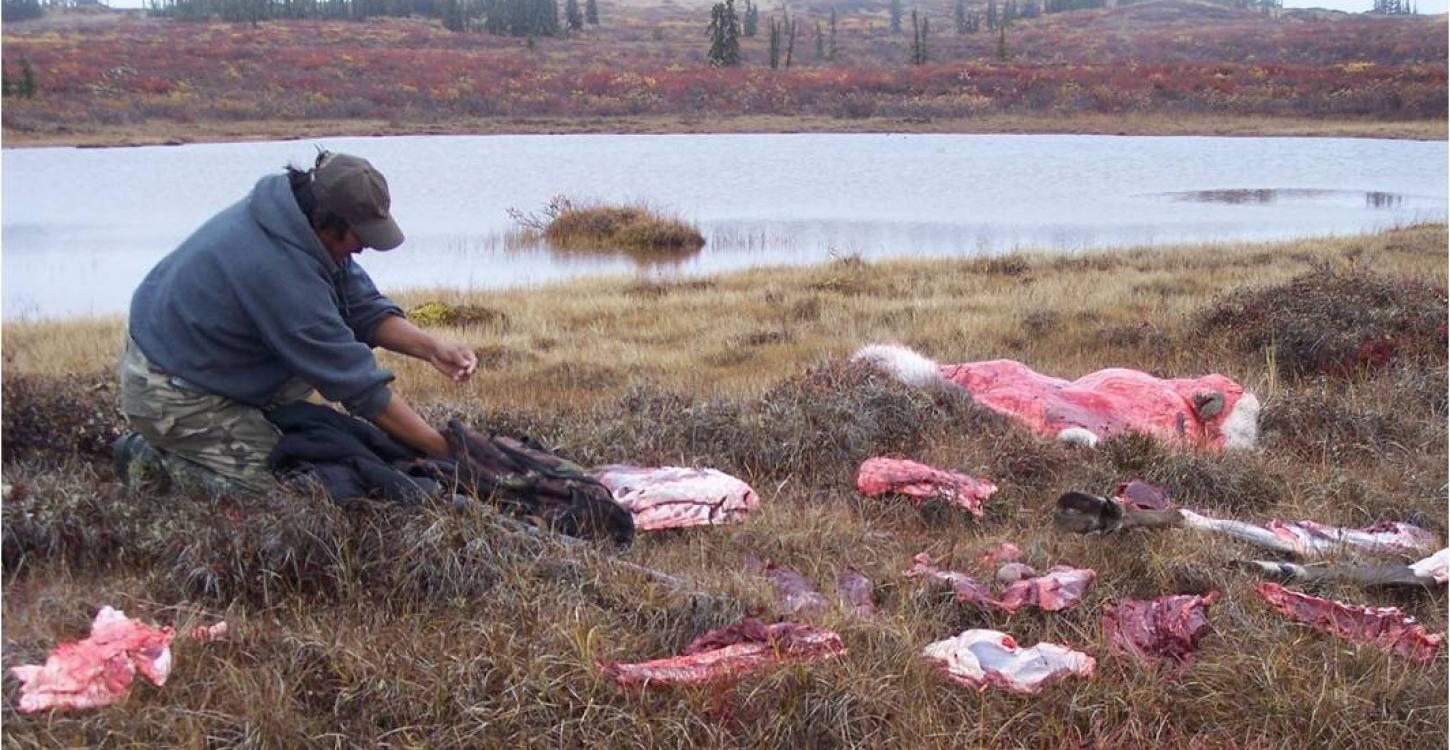
Community harvesters –with their intimate knowledge of caribou and the land—can be invaluable partners in this process. Through a new Tłı̨chǫ Caribou Health and Condition Monitoring Program, harvesters will be trained to collect biological samples to gain a better understanding of the caribou in-between surveys.
Harvesters can help us find out how the caribou are doing from information they collect themselves--and from their observations and knowledge of caribou.
On-the-land Caribou Monitoring Camp
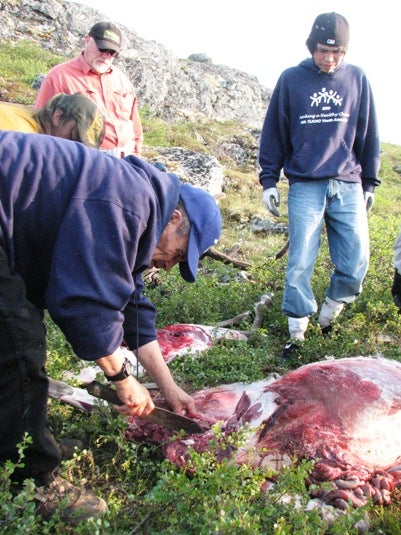
To begin the program, the Tłı̨chǫ Government, working with Environment and Natural Resources (ENR), GNWT, organized an on-the-land monitoring camp near Gamètì in March, 2013 to train harvesters and youth from each community about scientific sampling methods. Brett Elkin, wildlife veterinarian, ENR, provided the training.
At the camp, harvesters measured and recorded the depth of back fat to determine the body condition. They collected four samples: the lower jaw for aging the caribou; the left kidney for contaminant analysis; the lower back leg to assess body size and bone density; and fecal pellets to be tested for signs of parasites, diseases, diet analysis and pregnancy. Based on their observations, hunters also recorded an approximate age of the caribou, its sex, its general body condition, and the presence of any parasites such as warble flies.
As a follow-up, the harvesters met again in April in Behchokǫ̀ to reflect on their experiences at the monitoring camp and to share their observations of caribou sampled there. The sampling done at the camp was very successful. Participants found the sampling kits easy to use and had no difficulty taking the samples or recording the data. Once the sampling results are in, Brett Elkin will provide updates--most of the tests can be done quickly, in a month or so--but the tooth analysis for aging and tests for contaminants take a little longer, three or four months.
The group also discussed ideas for moving forward with the Tłı̨chǫ Caribou Monitoring Program, including using a 'train the trainer' approach where a few key people in the communities could act as a point of contact for community harvesters. This core group of trained monitors would distribute the sampling kits to other hunters and show them how to take samples and record data.
To support this process, the Tłı̨chǫ Culture and Lands Department, with support from WRRB and ENR, is working on a 'field guide' that hunters can take with them out in the field to do the sampling. The guide will have photos, diagrams and step-by-step instructions on collecting and storing the samples, a sample card already filled out to show how to record the information, and contact information for where where to drop off the samples.
The more people who are trained to do this basic monitoring, the better. The greater the number of caribou sampled at different times of the year, for different ages and sexes, the more information we have to put together a picture of how the herd is doing. How is a herd doing in summer, for example, compared with winter? Is the herd healthier in some years? How are yearlings faring compared with calves or adults? Are males healthier than females? Is one population healthier than another?
That information can also help find answers to questions related to population trends—whether the herd is stable, increasing or in decline. It may also help researchers unravel some of the reasons for population declines. Harvesters can help us find out how the caribou are doing from information they collect themselves—and from their observations and knowledge of caribou.