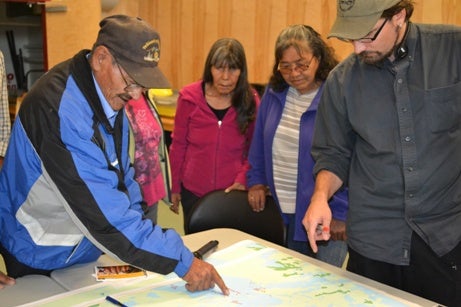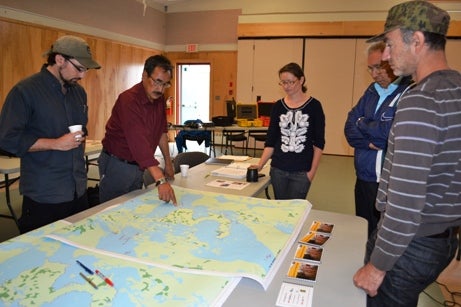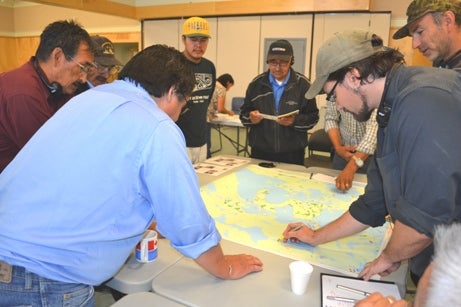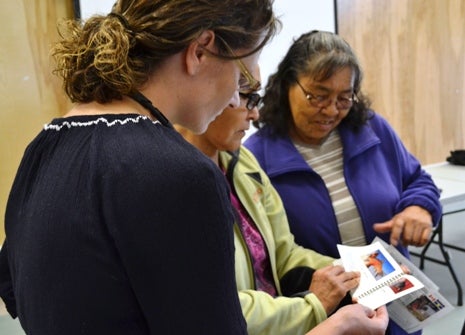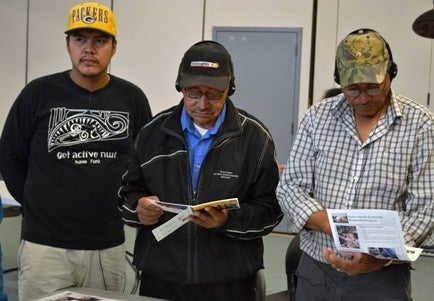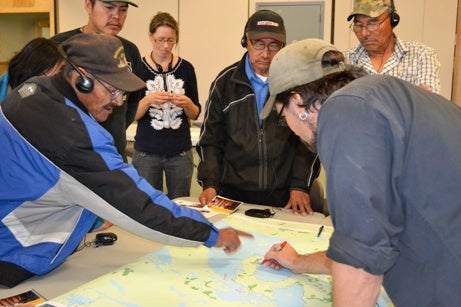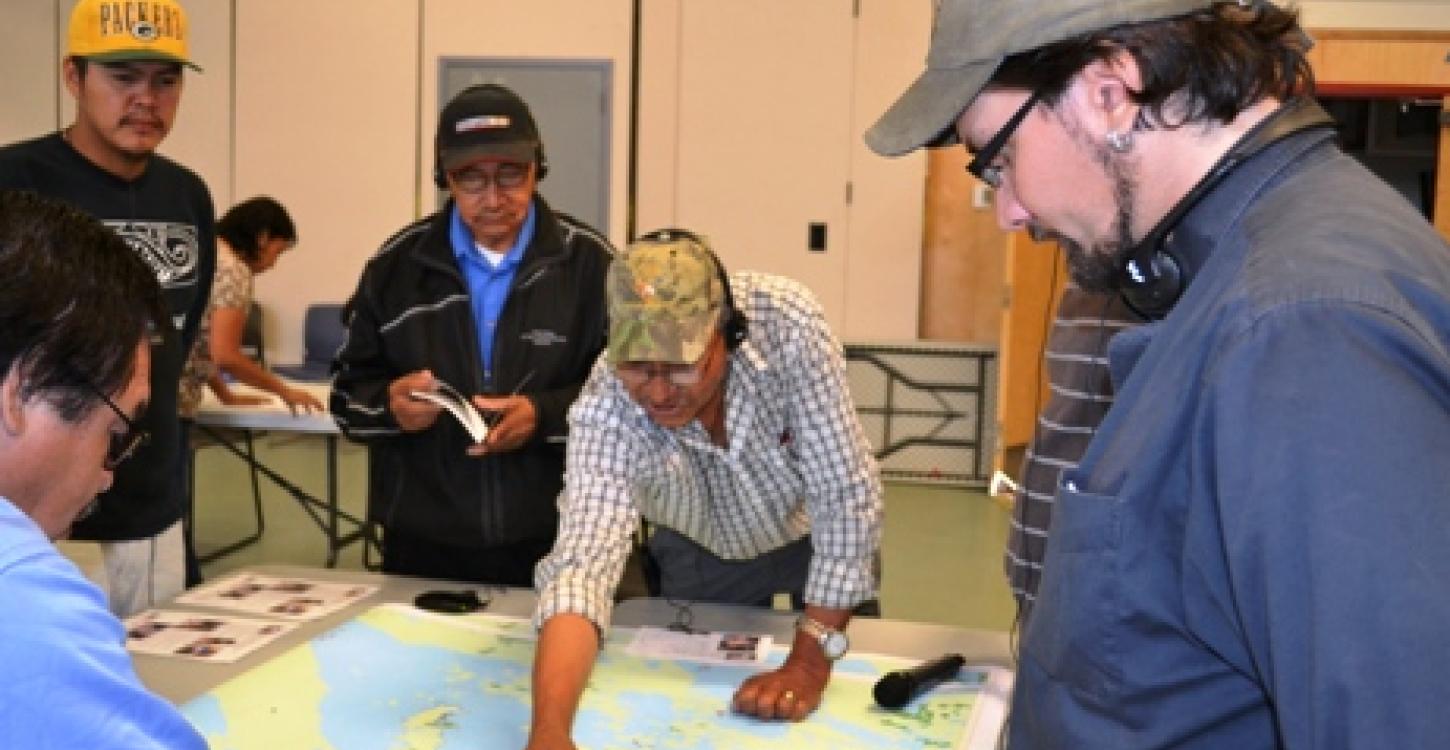
Plans are shaping up for September’s fish monitoring camp near Gamètì. At a meeting this month in Gamètì, community members met with Boyan Tracz, WRRB wildlife management biologist; Kerri Garner, Tłı̨chǫ Government Lands Department Director; and fish biologist Paul Vescei with Golder Associates, to put the finishing touches on the logistics for the fish camp’s location, timing and activities.
The five-day camp is part of the Tłı̨chǫ Aquatic Ecosystem Monitoring Program, a unique partnership that involves Tłı̨chǫ communities, the WRRB, the Tłı̨chǫ Government, the Wek’èezhìı Land and Water Board, and the Department of Fisheries and Oceans. The purpose of this community-based program is to monitor the health of fish and fish habitats near Tłı̨chǫ communities, using both science and traditional knowledge. The idea is to sample fish, water, and lake bottom sediments near Tłı̨chǫ communities to have a baseline or snapshot of environmental conditions now –and then return to the same lake four years later to repeat sampling and see if there have been any changes in that time. For example, researchers can compare results and see whether metals and other contaminants are increasing over time or are having an impact on fish –and notice other changes that may have occurred in the aquatic ecosystem.
The overall approach is that each year, a fish monitoring camp is set up near a different Tłı̨chǫ community. So far, there have been camps on Marian Lake, Russell Lake and Snare Lake. Next year’s camp will be held near Whatì and then the rotation through each community is planned to start up again.
Earlier in June, community members decided to focus the sampling on two fish species that are especially important food sources: Lake Whitefish and Lake Trout. At our August meeting, community members gathered around the map produced in June and further discussed camp and sampling locations. They decided where to set up the monitoring camp and identified a number of good places for setting nets and taking water and sediment samples –based on such factors as water levels at this time of year, where water for tea is taken, and available shelter for boats.
The camp brings together elders, youth, and scientists to learn from each other and to interact in a traditional camp setting. Youth will have an opportunity to hear from their elders about traditional ways to monitor fish health and water quality and along with other community members learn how to use scientific equipment and standardized methods to take samples and various measurements of fish, water and sediments. They will also be able to observe traditional Tłı̨chǫ methods for preparing fish such as making dry fish or smoking fish over a fire. Time permitting, we're hoping to include conservation education activities --anything from using a hand lens to examine whitefish scales to figure out how old the fish is--to using a dip net to discover the smaller creatures, invertebrates, that are part of the aquatic ecosystem.
Check our Fall Issue for a report on this year’s fish camp and photos!