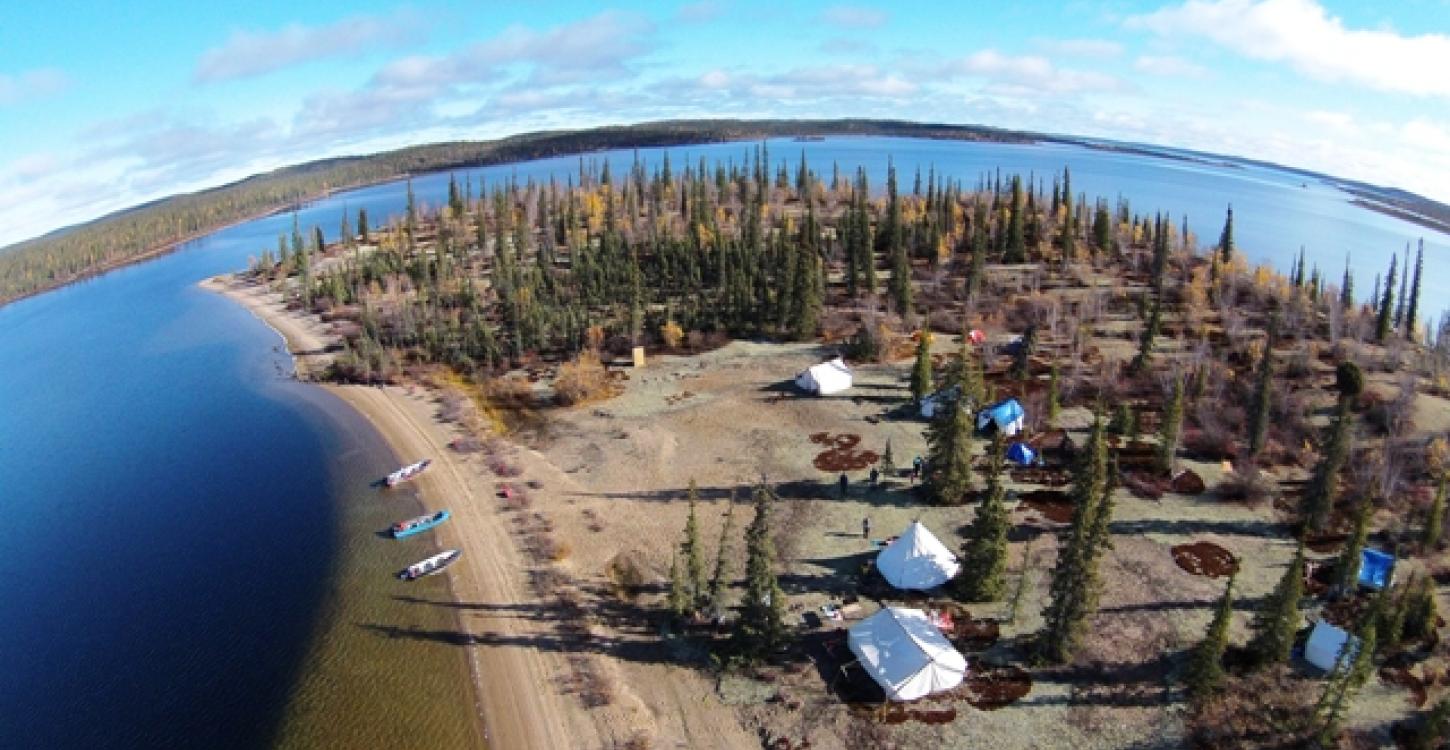
From September 19-23, 2016, the Tłı̨chǫ Aquatic Ecosystem Monitoring Program (TAEMP) returned to Wek’weètì to collect water, sediment and fish tissue samples as was done back in 2012, when the TAEMP last visited. Elders, youth, other community members, scientists and support staff worked together to collect the samples and exchange knowledge at fish camp, which was located on a point west of Wek’weètì (about 9km). Community concerns about the weather led the 2016 camp to be placed further west than where the 2012 camp had been located - on an island located about 6km west of Wek’weètì.
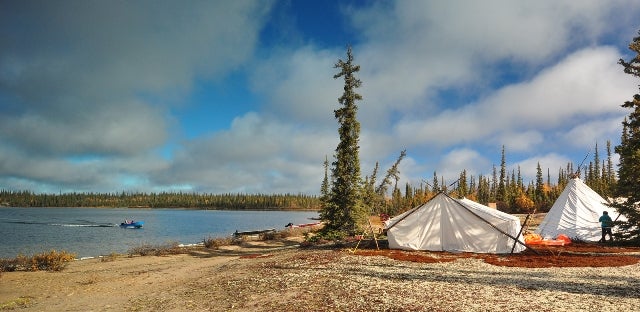
Fish camp site near Wek’weètì. Photo: Paul Vecsei, Golder Associates Ltd.
The TAEMP focuses on gathering samples near each of the four Tłı̨chǫ communities once every four years. This provides a way to track fish health and water quality, and provides a way to see if there are any changes in the aquatic environment over time. Starting in 2015, the TAEMP entered its comparative sampling phase, which involves collecting a second set of data near communities which is then compared to baseline data collected earlier. For example, the TAEMP was last in Wek’weètì four years ago, from September 10-14, 2012. Using standard methods and equipment, 2016 camp participants collected water, sediment and fish near the same locations visited in 2012 to allow for comparison. Also, at the community members’ request, three additional water and sediment locations west of the camp were sampled. In 2012, bad weather limited where and how samples were collected. However, in 2016, weather was quite good, with only wind on Friday morning affecting water and sediment sample collection at two locations nearest to Wek’weètì.
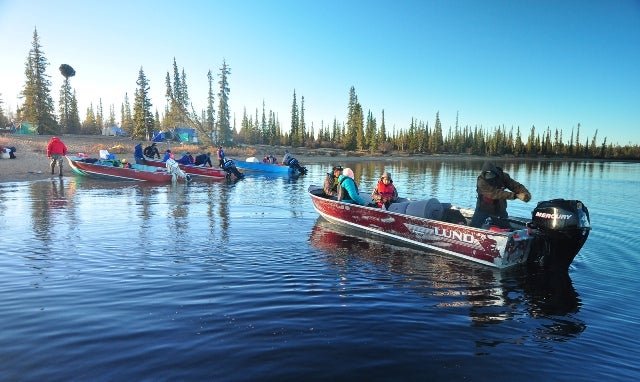
Setting out by boat. Photo: Paul Vecsei, Golder Associates Ltd.
Through cooperation among participants, fish were caught in nets to provide food for the traditional camp, and to provide samples for analyses. Tissue samples were successfully collected from 20 Łiwezǫǫ̀ (Lake Trout) and 20 Łih (Lake Whitefish). Paul Vecsei, Fisheries Biologist, Golder Associates Ltd., along with assistance from Ryan Gregory, Watershed Programs and Partnership Technical Support, ENR, demonstrated how fish are processed in order to collect information. For example, tissue samples are used to determine concentrations of mercury and other contaminants in the fish, otoliths, or “ear bones”, are used to determine the age of each fish, and body measurements including weight and length help to better understand fish health and growth rates.
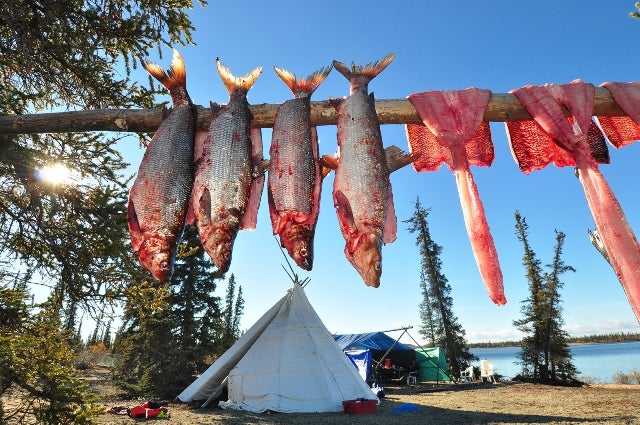
Dry fish preparation at fish camp. Photo: Paul Vecsei, Golder Associates Ltd.
Elders from Wek’weètì, including Joseph and Madeline Judas, Charlie and Marie Adele Football, and Jimmy and Noella Kodzin, led visits to grave sites in the area, sharing their Tłı̨chǫ knowledge and cultural practices with the youth and other participants. Elders also demonstrated how to repair nets and process fish, with youth assisting with cleaning and preparation of fish. While youth departed the camp earlier than expected on Thursday, community members were able to continue site visits and activities.
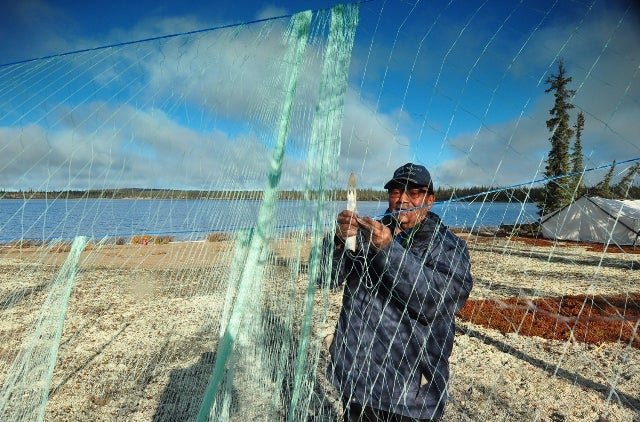
Elder Charlie Football demonstrating how to mend a net. Photo: Paul Vecsei, Golder Associates Ltd.
Youth from Alexis Arrowmaker School also helped Sean Richardson, Wildlife Coordinator, Tłı̨chǫ Government, and Roberta Judas, Regulatory Technician, Wek’ èezhı̀ı Land and Water Board, collect water and sediment samples using scientific equipment and techniques. Prior to getting into the boats, on-shore demonstrations were given on how to properly take water and sediment samples using standard procedures, including how to lower the Ekman dredge into the water to pull up mud and sediment from the bottom of the lake.
Water, sediment and fish samples will now be analysed in labs, and after lab results are received and reviewed, information will be provided to Wek’weètì community members. Once analyzed, the fish, water and sediment samples will provide the first set of comparative data for Wek’weètì. It will be interesting to see if there are any differences between the information collected in 2012 and the new information from 2016. The TAEMP support staff hopes to be back in Wek’weètì early in the new year to present and discuss results with interested community members.
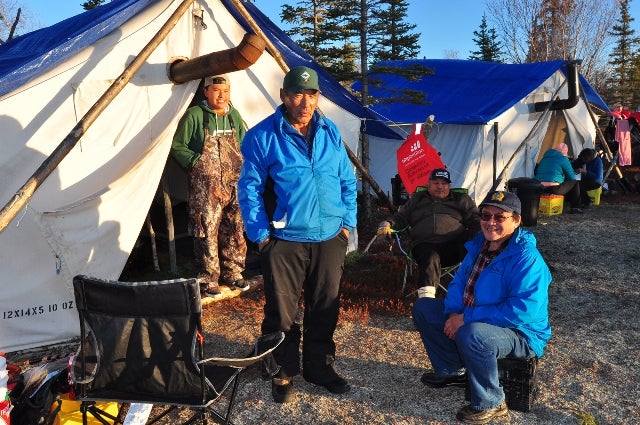
Youth Noah Kodzin, Jimmy Kodzin, Joseph Judas and Jonas Lafferty enjoying good company and weather at fish camp. Photo: Paul Vecsei, Golder Associates Ltd.
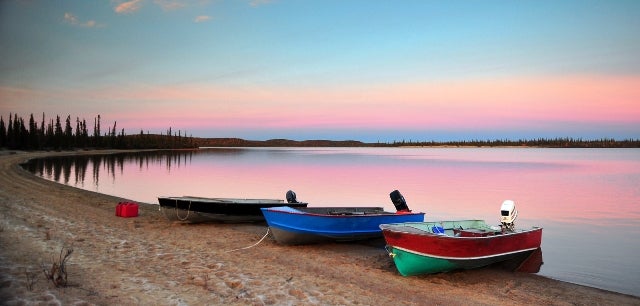
Sunset at fish camp. Photo: Paul Vecsei, Golder Associates, Ltd.
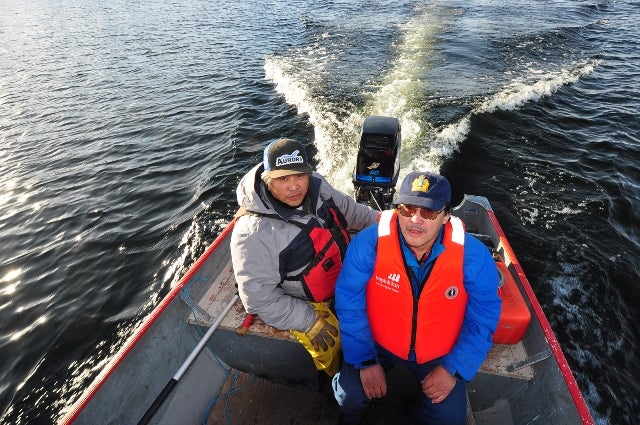
Former WRRB Board Chair Joseph Judas and Board member Jonas Lafferty setting off by boat (Photo: Paul Vecsei, Golder Associates Ltd.)
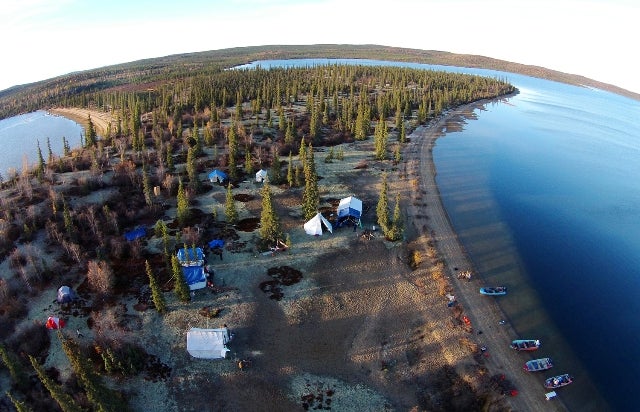
Aerial view of this year's fish camp, showing its location on a point of land near the community of Wekweètì. You can see boats lined up ready for sampling fish, water and lake sediments. (Photo: Paul Vecsei, Golder Associates Ltd.)
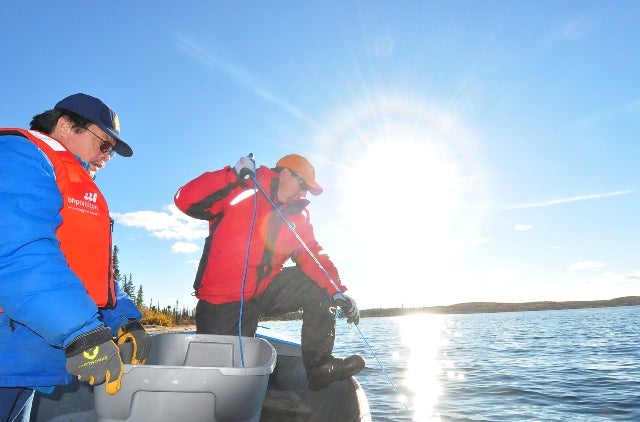
WRRB Board member Jonas Lafferty and Ryan Gregory, Water Resources, ENR, GNWT
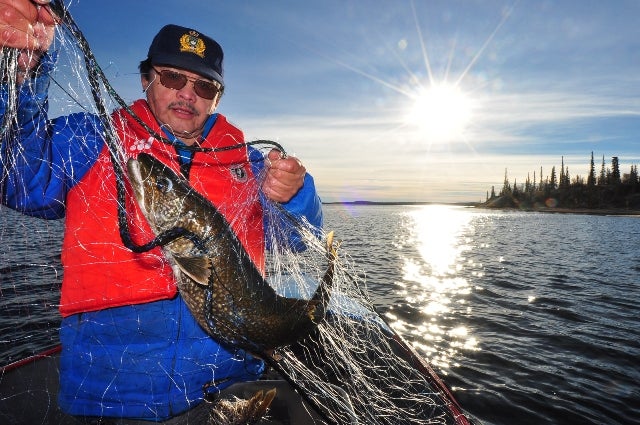
WRRB Board member Jonas Lafferty pulling in a Łiwezǫǫ̀ (Lake Trout). Photo: Paul Vecsei, Golder Associates Ltd.
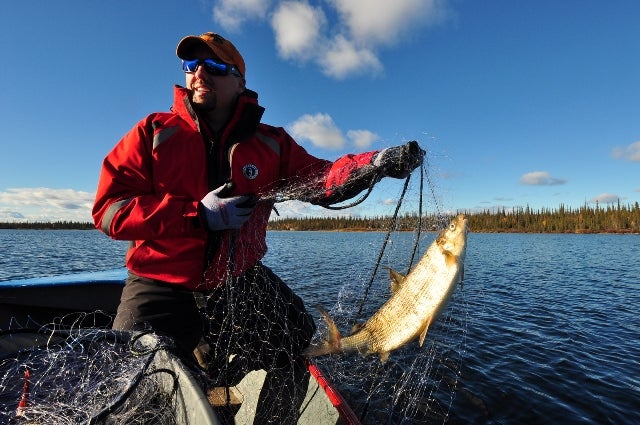
Ryan Gregory, Water Resources, ENR, GNWT pulling in a Łih (Lake Whitefish). Photo: Paul Vecsei, Golder Associates
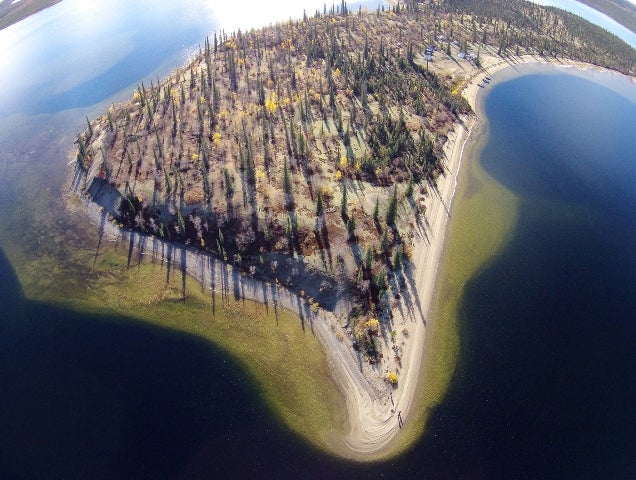
Aerial view of the point where this year's fish camp was set up. Photo: Paul Vecsei, Golder Associates Ltd.