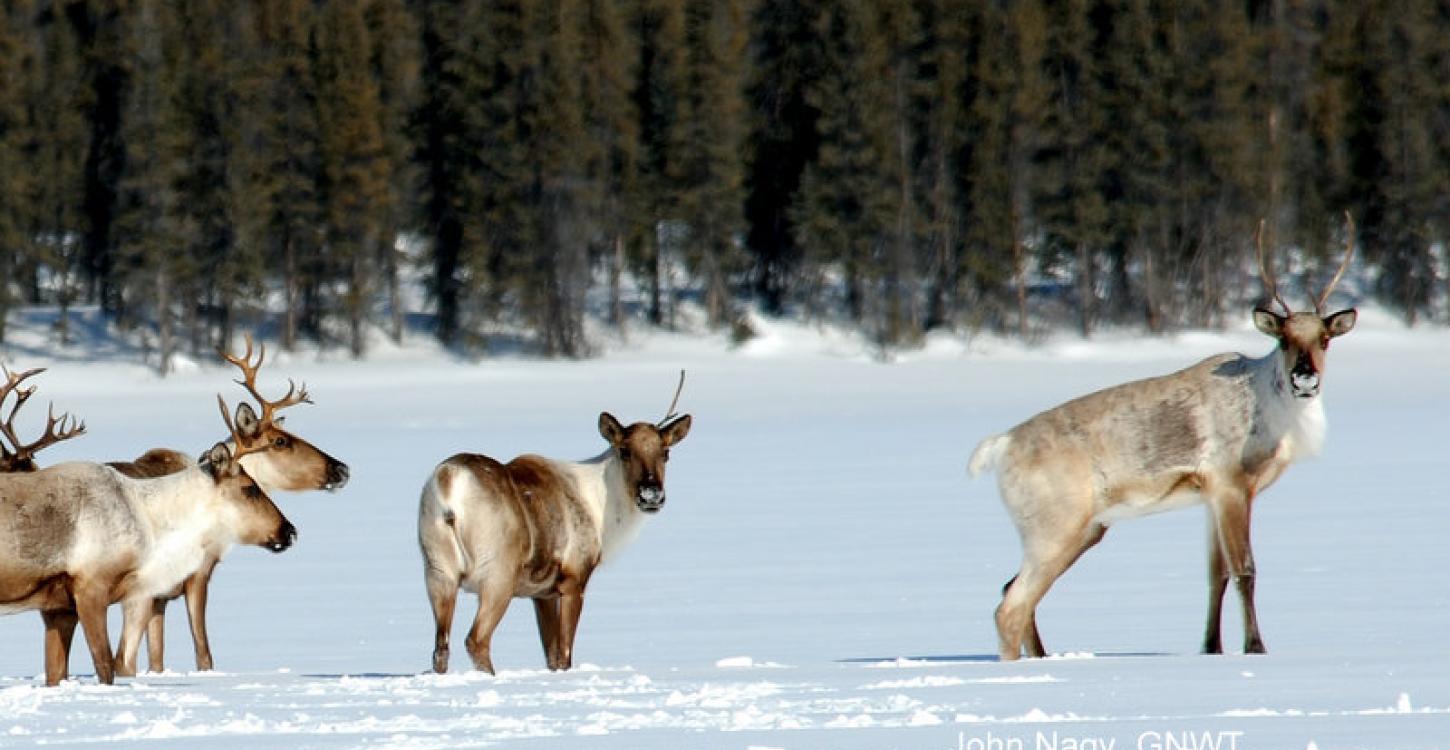
Throughout North America, caribou and their homes in the boreal forest and on the barren-ground tundra are facing increasing threats. Northerners are well aware that the some barrenground caribou herds have seen declining numbers in recent years, but may not be aware of how our boreal caribou are doing. They are listed as threatened under the federal Species at Risk Act (SARA) and this December, 2012, Boreal Caribou were assessed by the NWT Species at Risk Committee (SARC) as threatened in the NWT . Boreal caribou appear to be faring better here in the North than elsewhere, but we need to learn more about these caribou to manage and protect them for the future.
The Wek’èezhìı Renewable Board and the Tłı̨chǫ Government are working together on a project to learn more about the boreal caribou habitat and habitat use in Wek’èezhìı. Boreal caribou need large, undisturbed ranges to thrive. Loss or fragmentation of habitat–disturbing or breaking a habitat into smaller isolated areas--is likely their greatest threat. That can happen from natural or human disturbances: forest fires, resource development, and road construction, for example.
Funded by the federal Aboriginal Funds for Species at Risk and the NWT Species at Risk Stewardship Fund, this project set out to learn more about the tǫdzı or boreal caribou from a Tłı̨chǫ perspective and to collect existing scientific data. The work completed in March 2012 is a first step towards gaining a better understanding of the behavior, characteristics, movements, distribution, and habitat preferences of tǫdzı. The project is ongoing through to March 2013.
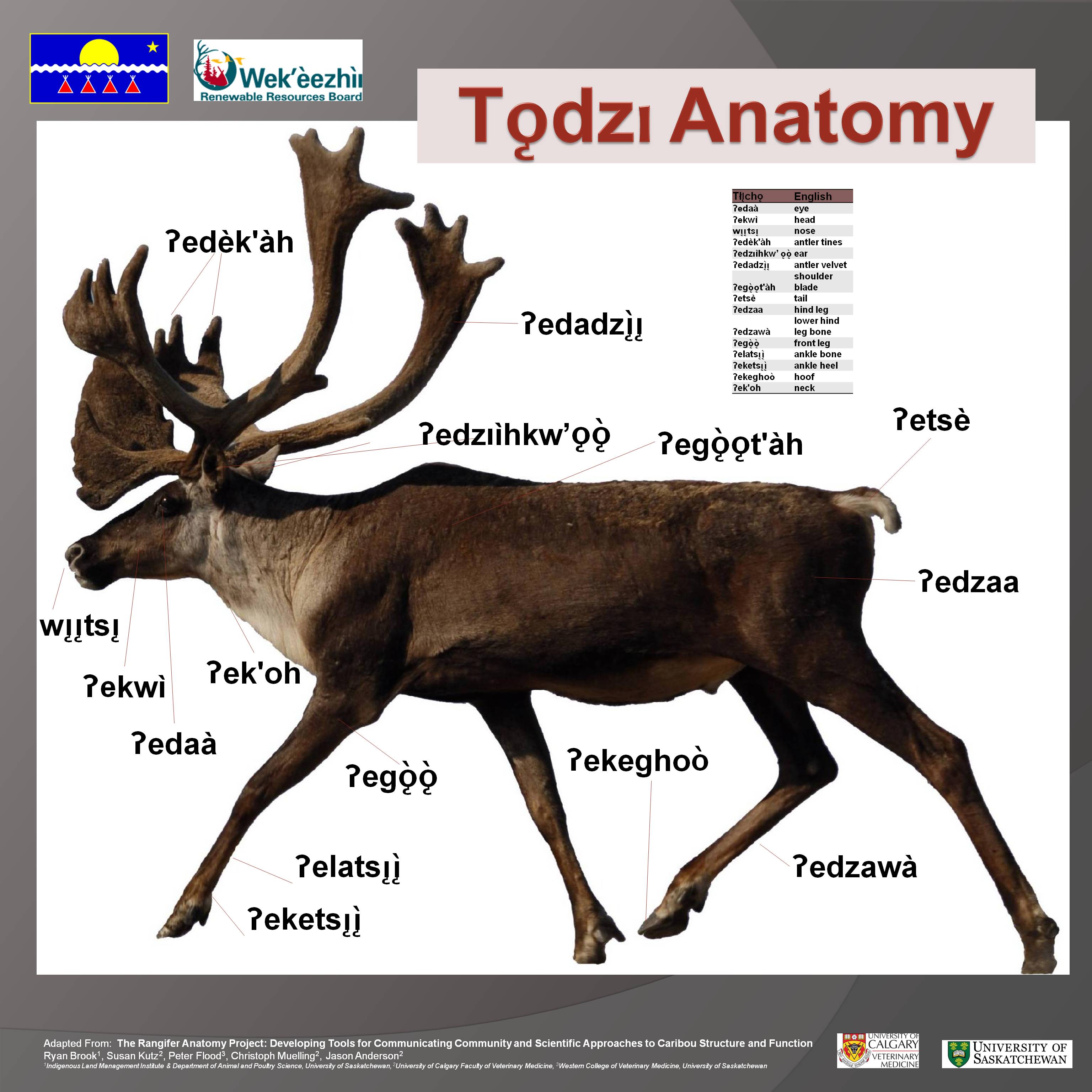
The information collected is available in the Boreal Caribou Habitat and Habitat Use in Wek’èezhìı Report under two sections: the Tłı̨chǫ Knowledge Component and the Scientific Component. Led by Georgina Chocolate and Allice Legat, the Tłı̨chǫ knowledge team met with eight elders from Behchokǫ̀ and Whatì to document locations where tǫdzı were seen or harvested; birthing locales; the importance of islands and hills; and the vegetation that the caribou forage. Caribou distribution maps from a Tłı̨chǫ perspective were produced, along with a poster documenting Tłı̨chǫ terms for the caribou’s anatomy and the final report. Researchers put together a picture of tǫdzı distribution from harvest areas, observations and oral narratives. Participants shared traditional practices and guidance for a respectful relationship with tôdzi. Researchers also documented how the caribou’s movements and use of terrain protect them from predators such as wolves, lynx, and bears. Participants described tǫdzı as secretive and fast –elusive animals that startle easily and are difficult to track and hunt because they are hard to spot in the brush. Understanding the character of boreal caribou will be valuable when thinking about their habitat requirements. The team met again at a fall camp to continue to research and document Tłı̨chǫ knowledge of boreal caribou.
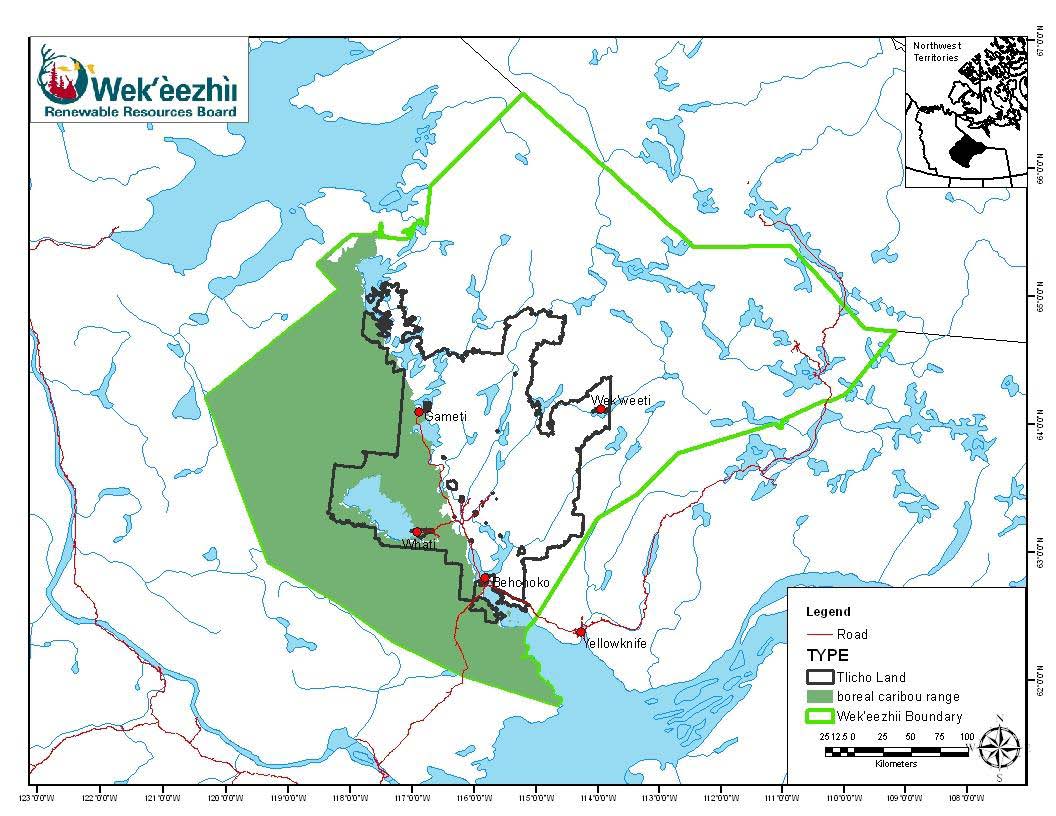
The science information gathered from the GNWT, an independent researcher and the Canadian Wildlife Service supported these findings and yielded some numerical data. Boreal caribou inhabit 31% of the total area of Wek’èezhìı and 16% of the area within Tłı̨chǫ lands. Found in small groups loosely dispersed across their range, the average density of boreal caribou within Wek’èezhìı is 1.38 caribou for every 100 square kilometers. Using that estimate and the size of their range, researchers have calculated that there are an estimated 650 boreal caribou in Wek’èezhìı.
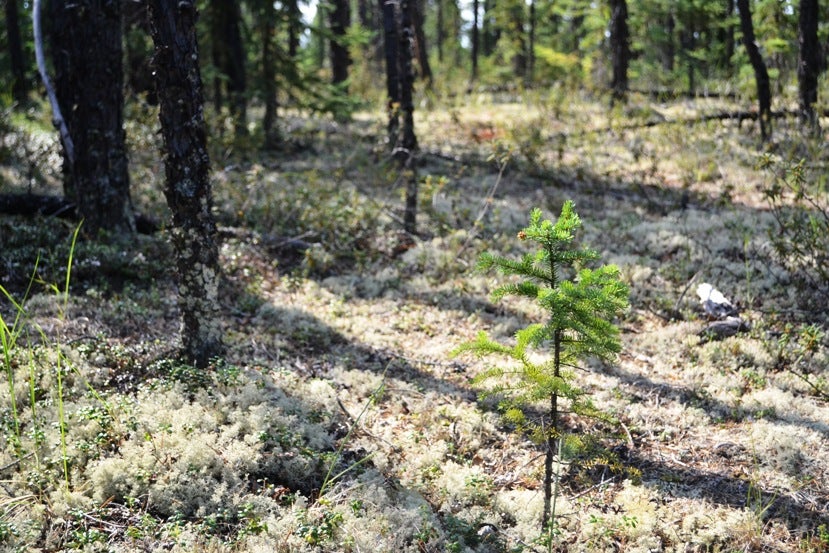
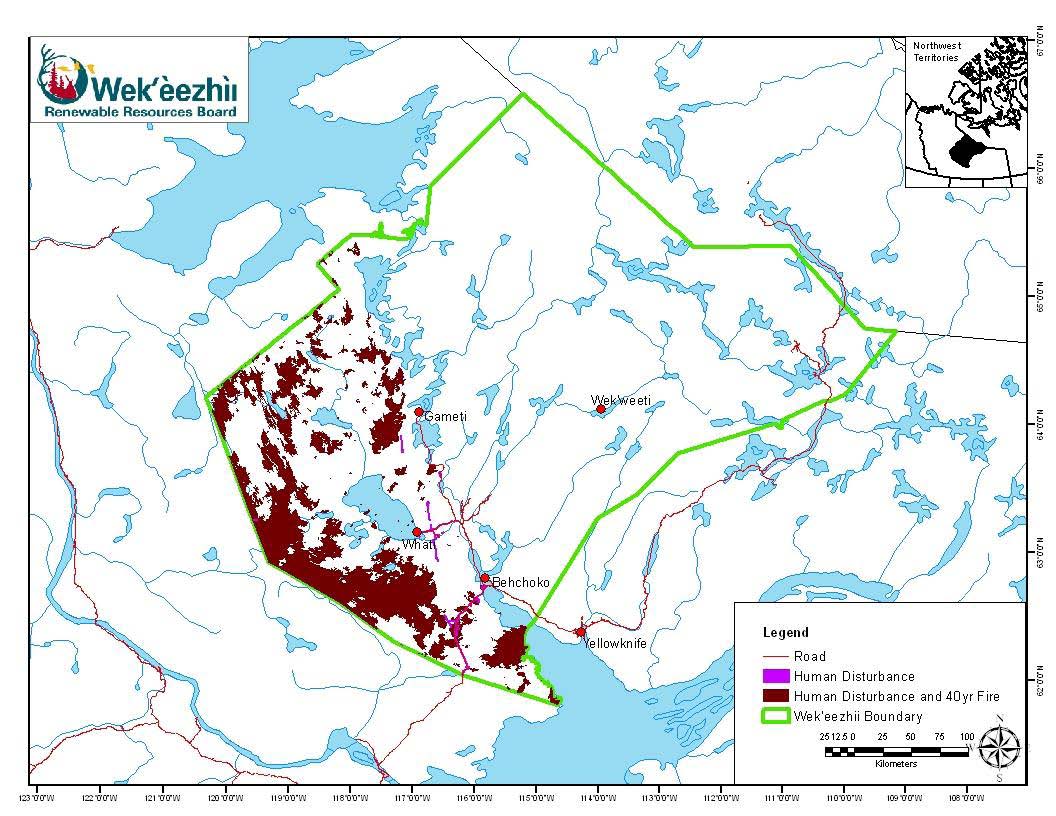
They also looked at the fire history in the area and concluded that most of the disturbance on the caribou’s range is a result of fire. Boreal caribou prefer mature forest stands and fire can affect the availability of the lichens, willows, mushrooms, grasses, and other plants caribou feed on. Forest fire and human disturbance can result in changes to the landscape that may cause caribou to change their movements. Much of their habitat is still relatively intact. There is still a large amount of unburned habitat left in Wek’èezhìı–and so far, there is very little human disturbance. But the amount of disturbance that is there now is right at the threshold of a line that divides caribou populations that can sustain themselves –and those that cannot. Any further disturbance might put Wek’èezhìı’s boreal caribou at risk.
That’s why this project is an important start and why more research is needed. Boreal caribou may be able to continue to use the strategies they have used in the past to survive—and thrive. But we need more information to understand how their numbers, distribution and behaviours might be affected by future disturbance. We need to take a closer look at burn areas –how they are used by the caribou and how long it takes for them to regenerate back into places where they can forage. Will they continue to be resilient when faced with long term changes in their habitat due to fires or development? Will they still be able to reach the upland areas they need for calving or the islands that are important for rearing their young? How will climate change affect their habitat, the “places where they belong”?
Did You Know…
The earliest fossil evidence of caribou comes from Germany and has been dated to about 440,000 years ago?
Boreal Caribou Fact File
-
- Boreal caribou in the NWT were assessed in December 2012 by the NWT Species at Risk Committee as a threatened species
- A threatened species is a species that is likely to become endangered if nothing is done to reverse the factors leading to its extirpation (disappearance from Canada) or extinction (no longer exists anywhere in the world).
- Boreal caribou are listed as threatened under the federal Species at Risk Act (SARA)
- Currently, of 57 boreal caribou ranges in Canada, 58% were identified as not sustaining viable populations (Environment Canada 2011).
- There are currently about 32,000 boreal woodland caribou remaining in Canada, according to Environment Canada. At least half of the caribou's range has been lost due to activities that disturb and fragment their forest habitat.
- The population of boreal caribou in the NWT has been estimated at around 6,500 animals but Boreal caribou sightings tend to be more infrequent and more research is needed.
- The Government of Northwest Territories (GNWT) developed an NWT Boreal Woodland Caribou Conservation Action Plan in 2009 in support of a National Recovery Strategy for Boreal Caribou.
- This plan recommends habitat planning and management as tools to address threats to boreal caribou.
Photo Gallery Description:
The first image is a map showing the range of woodland boreal caribou range in Wek’èezhìı (data from ENR, GNWT).
A second map shows areas of natural and human disturbance in Wek’èezhìı. (data from Environment Canada and ENR, GNWT). Forest fires are the predominant natural disturbance in this area. Human disturbance has been minimal to date and is the result of forest clearing associated with settlements, exploration and resource extraction. Environment Canada used the past 40 years of fire to indicate areas of naturally disturbed habitat. Together with human disturbance this accounts for approximately 35% of the boreal caribou range in Wek’èezhìı.