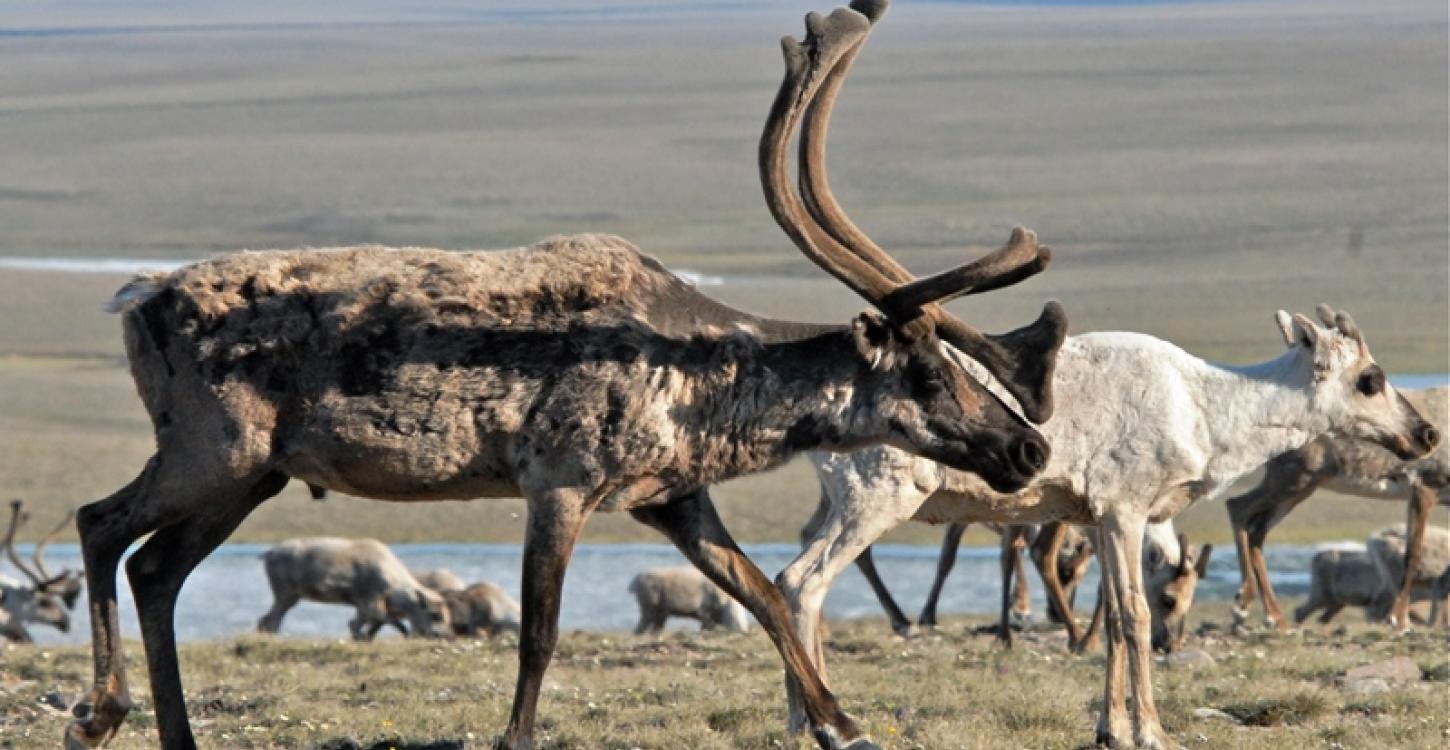
Over the fall 2014, and early this winter 2015, Environment and Natural Resources (ENR), GNWT, met with Aboriginal leaders and wildlife management boards, including the WRRB, to review information on the Bathurst and Bluenose-East Caribou herds and to discuss possible management actions. The results of a reconnaissance survey in June 2014 along with other monitoring suggest that both herds have continued to decline.
Mobile Core Bathurst Caribou Conservation Area
At its January Board meeting, the WRRB passed a motion to support ENR’s proposal to establish a mobile conservation area to help the Bathurst caribou herd over the 2014/2015 harvest season. The mobile “zone” is centred around the core of the Bathurst caribou herd, and no harvesting is permitted in the zone. The Board also supported the requirement for authorization cards for harvesting caribou outside the mobile zone in Wek’èezhìı (R/BC/01, R/BC/02, and R/BC/03). The mobile zone was established through GNWT regulations and will be in place until June 30, 2015. ENR and co-management partners will revisit the approach this fall when new information on the herd’s status is available, including an estimate of the Bathurst herd’s population size which will be provided by a photo survey planned for June. Based on the survey results and what they suggest about population numbers and trend, decisions will be made to either continue with the mobile zone approach, or consider other actions to assist the herd’s recovery.
Bluenose East Caribou Herd
The 2013 population estimate, 2014 reconnaissance survey results, and other monitoring indicators, suggest that the Bluenose East herd has continued to decline. The results of ENR’s population survey of the herd in 2013 found it had declined to about 68,000 caribou from more than 100,000 in 2010. A population estimate survey for Bluenose-East Caribou is planned for June 2015.
The Advisory Committee for Cooperation on Wildlife Management (ACCWM) submitted a management plan for the Cape Bathurst, Bluenose-West and Bluenose-East caribou herds to GNWT and other governments in November, 2014. The management plan, “Taking Care of Caribou” identifies when certain actions should be taken for defined population level thresholds. During the interim while governments review the management plan, the ACCWM recommended that harvest of Bluenose-East caribou be limited to 1,800 animals for the NWT for the 2014/2015 harvest season, with a majority bull harvest, emphasizing younger and smaller bulls and not the larger breeders and leaders.
The GNWT accepted the ACCWM’s recommendations for an overall approach to manage the Bluenose-East Caribou harvest for the winter 2014/2015 harvest season. The ACCWM is currently working on an Action Plan for the Bluenose-East caribou herd, based on both science and traditional knowledge, and including input from communities.
Bathurst Caribou and Bluenose-East Caribou Monitoring 2015 / 2016 Harvest Season
In January, the WRRB received a proposal from ENR for the monitoring of Bathurst and Bluenose-East Caribou herds. At its January meeting, the WRRB supported the proposed actions to ensure that relevant information is available for making effective management decisions for the herds.
The Board decided to support ENR’s wildlife research permit application to increase the number of collars to a total of 50 for each herd. Of these, 30 collars would be placed on cows and 20 collars on bulls in each herd. The additional collars will enhance the ability to monitor the movement and distribution of migrating caribou, assist with the photocensus that is planned for each herd in June, and provide other valuable information on each herd’s population, such as information on cow survival.
The WRRB also supported ENR’s application to conduct a spring recruitment survey to measure annual calf survival for both the Bathurst and Bluenose-East Caribou herds, and a fall composition (sex ratio) survey for both herds. The spring and fall surveys are two important indicators of caribou herd health.
The size of a caribou herd depends on how many calves are born and survive and how many adult animals, primarily the cows, die during the year. A spring recruitment survey is conducted in late March or April each year when calves are nine or 10 months old. It’s assumed that these calves which have survived through the winter are “recruited” into the adult population. That estimate, along with other monitoring information, helps build a picture of how the herd’s population is doing –whether its population is growing, stable, or declining. Surveys have indicated that recruitment has been low for the past two years, and the number of breeding cows is also down.
The fall survey is conducted during the rut in mid October and is designed to assess the number of bulls compared to cows—a measure that can be used along with other information as an indication of whether a herd is growing, stable or declining. This ratio of bulls to cows in the herd is also used along with calving ground photo survey results to estimate the total population size. The next calving ground photo censuses for the Bathurst and Bluenose-East herds are planned for June 2015.