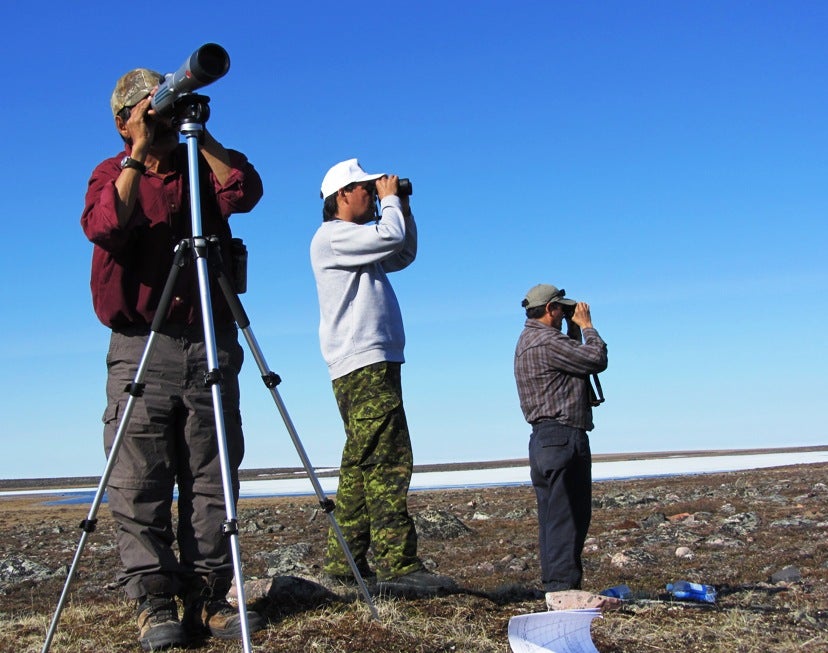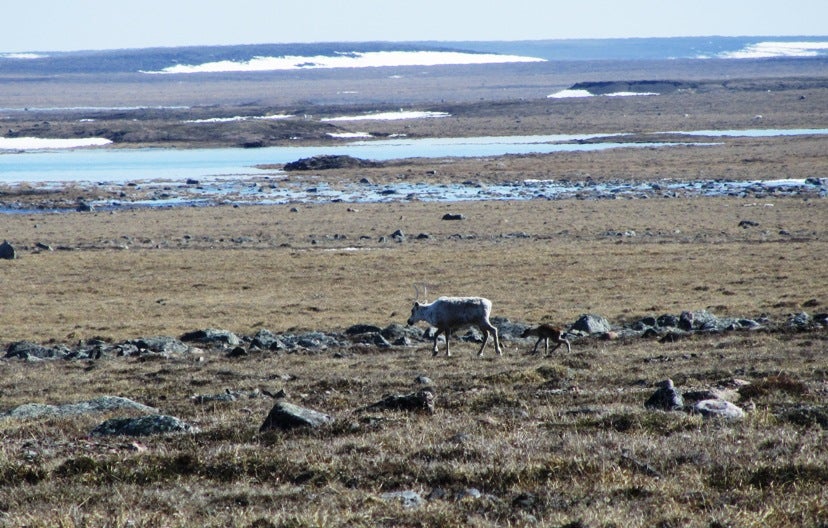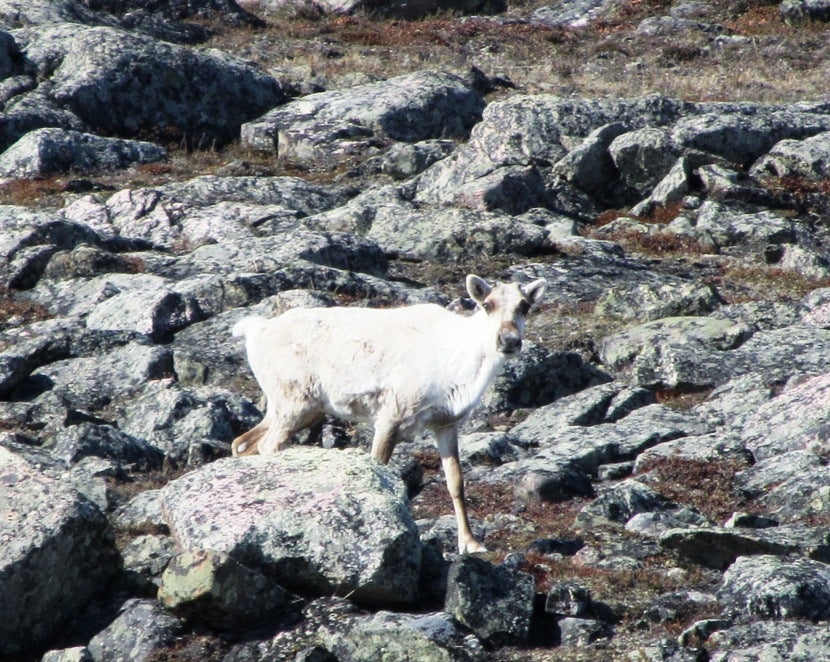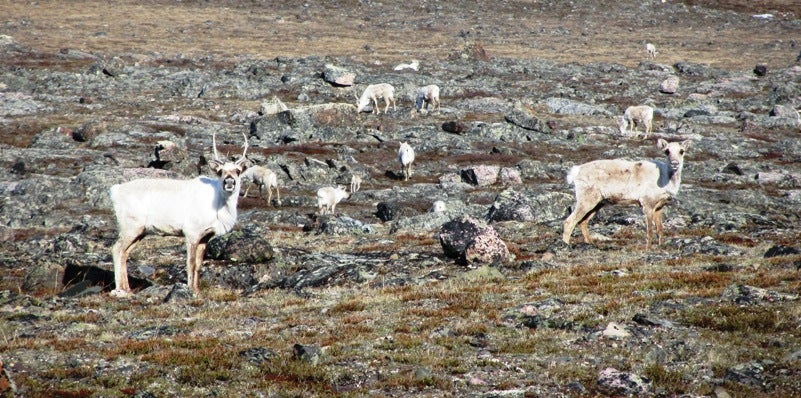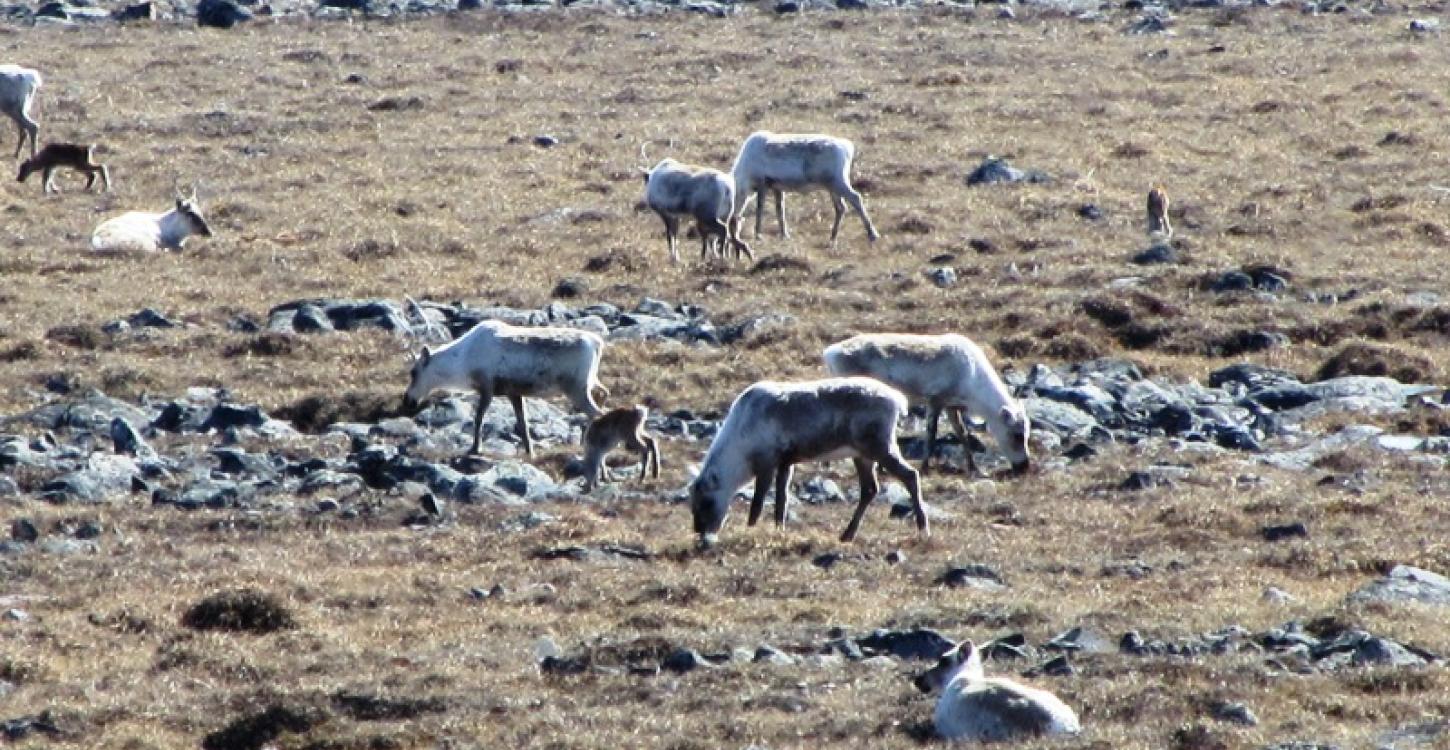
Karin Clark, the WRRB’s wildlife management biologist, participated in GNWT’s aerial survey of the Bathurst Caribou herd in June 2012. ENR biologists and a statistician, along with assistance from WRRB, Tłįcho (Tlicho) Government and other community observers, conducted a photo survey during the week of June 3 – 8 to estimate the number of breeding cows in the herd. Weather conditions were excellent and researchers were able to time their survey for “peak calving”, a period when at least half of the cows on the calving grounds have had their calves.
Population surveys are done at times in the annual life cycle when large numbers of caribou gather together, such as each year’s calving in June. At that time, there are mostly breeding cows on the calving grounds along with a few bulls, yearlings or non-breeding females.
The first step in the survey is a fly over –or a reconnaissance flight--to define the boundaries of the area to be surveyed. Where the caribou are in greatest numbers and grouped closely together, it is too difficult to count them visually, so they are photographed by a specially designed aircraft. Where the caribou are fewer in number and more spread out, another plane is used where observers on either side of the plane count all the caribou within a set area.
Following the flying of transects, a composition survey is conducted on the calving ground where caribou are classified as calves, yearlings and cows – breeders / non-breeders to adjust the total caribou counted on the calving ground to reflect the number of breeding females.
The calving ground survey gives researchers a good picture of how many breeding females there are but an estimate for the entire herd has to include adult male caribou. As there are few bulls found on the calving grounds they cannot be counted at this time. A composition survey is done either the following fall or in the fall previous where the number of bulls and cows is counted and a bull to cow ratio is calculated. From that ratio, the number of bulls can be estimated for the herd and added to the number of breeding cows counted on the calving ground. Comparing this new estimate with previous estimates will determine whether the population trend is stable, decreasing, or increasing.
Counting caribou is a time-consuming task –both on the aerial surveys and afterwards in the lab where thousands of photos have to be examined. Caribou from the June surveys were counted –and the composition survey work was completed last fall to arrive at the final population estimate for the Bathurst Caribou.
What happens now that the new Bathurst Caribou Herd Population estimate has been released?
The Board will review any new management proposals based on the results of the 2012 population survey of the herd and make its recommendations. In its assessment, the Board will consider current information from a number of different sources, including government reports, hunters’ observations and knowledge, academic studies, survey updates, habitat conditions and harvest data.
The current harvesting target of 300 animals (80% bulls) for the Bathurst Caribou herd remains in place until March 2013 - or when new management actions are implemented.