This spring, the Board made final determinations on harvest for two barren-ground caribou herds, the Bathurst herd and the Bluenose-East herd, setting a total allowable harvest (TAH) of zero for the Bathurst caribou and a TAH of 750 bulls for the Bluenose-East caribou over the next three years, from 2016 to 2019.
Earlier, in January 2016, the Board had opened two proceedings, one to address a joint management proposal for the Bathurst caribou herd, submitted by the Tłı̨chǫ Government and Environment and Natural Resources (ENR), GNWT; and the other to address the two governments’ proposed management actions for the Bluenose-East caribou herd.
The populations of both barren-ground caribou herds have experienced rapid declines in recent years. Each proposal called for a total allowable harvest (TAH), proposing the closure of all harvesting for the Bathurst caribou herd, and limiting the harvest of Bluenose-East caribou to 950 bulls. A TAH is a total amount of a wildlife population that may be harvested annually.
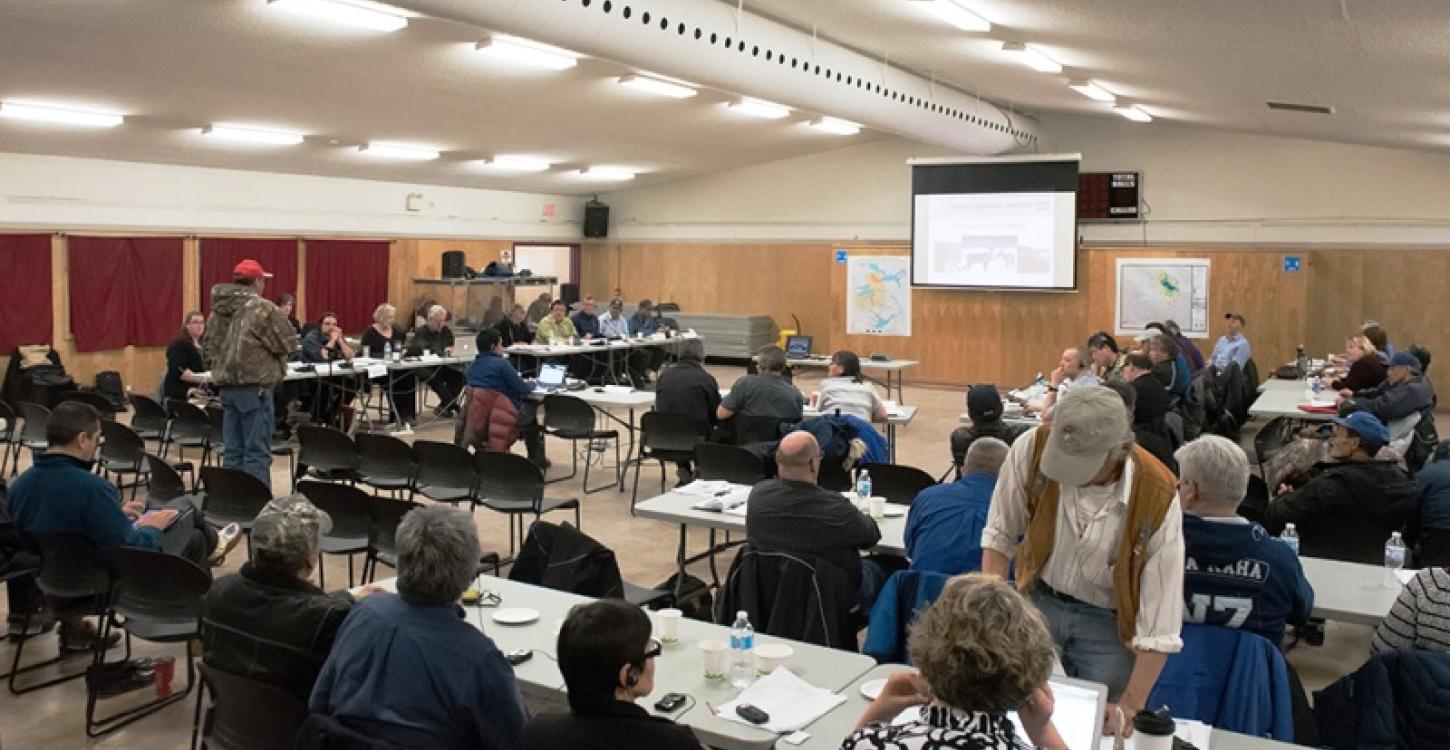
To meet the terms of the Tłı̨chǫ Agreement, the WRRB held public hearings to address the proposed harvest limitations for the two herds. A public hearing for the Bathurst caribou was held in Yellowknife on February 23-24, 2016, and a public hearing for the Bluenose-East caribou was held in Behchokǫ̀ on April 6-8, 2016.
After reviewing all the evidence on the public record, the Board issued its determinations on harvest and recommendations on other management actions in two final Reasons for Decision reports. The Board’s Reasons for Decision report, Part A, for the Bathurst proceeding was submitted to the Tłı̨chǫ Government and ENR on May 26, 2016, and its Reasons for Decision report, Part A, for the Bluenose-East proceeding was released on June 13, 2016. These reports are available on the Board’s website at http://wrrb.ca/public-information/public-registry. The Board will issue a Reasons for Decision report, Part B, for both the Bathurst and Bluenose-East proceedings by the end of August 2016. The Part B report will include the Board’s recommendations on additional management actions, biological and environmental monitoring, and cumulative effects.
Here is more information on each of the Board’s proceedings.
Bathurst Caribou Proceeding:
In December 2015, the Tłı̨chǫ Government and ENR submitted the Joint Proposal on Caribou Management Actions for the Bathurst Herd: 2016-2019 to the WRRB. It proposed new restrictions on hunter harvest, predator management to reduce wolf populations on the Bathurst caribou’s winter range, and ongoing biological and environmental monitoring. Specifically, the Tłı̨chǫ Government and ENR proposed the closure of all harvesting of the Bathurst caribou herd, including Aboriginal harvest
At its public hearing in February, 2016, the Board heard evidence from the Tłı̨chǫ Government and GNWT, and from the two intervenors in the proceeding, the North Slave Métis Alliance and the Yellowknives Dene First Nation. The Board also received comments from the general public. The transcripts of the Bathurst public hearing are available on the WRRB’s public registry at http://wrrb.ca/public-information/public-registry
The WRRB reviewed traditional knowledge and scientific information related to barren-ground caribou, and in particular, the Bathurst caribou, as well as other topics related to the proposed management actions before the Board.
It decided to prepare two separate reports, the first (Part A) to focus on the governments’ request for a total allowable harvest, which it submitted on May 26, 2016 to allow time for legislation to be developed and come into effect in time for the upcoming harvest season. The Board is currently preparing Part B which will deal with additional management actions, biological and environmental monitoring, and cumulative effects and will submit this second report in August 2016.
In this Reasons for Decision report, Part A, the Board includes its determination that a TAH of zero be implemented for all users of the Bathurst caribou herd within Wek’èezhìı for 2016-2019. It concluded that the herd is in crisis given the continuing decline in the breeding females, poor vital rates, impacts of environmental factors such as poor summer feeding conditions, and development on the herd’s annual range.
The Board also recommended regular monitoring of the caribou wildlife management units and Bathurst caribou harvest from 2016-2019. As well, the Board recommended that hunter education programs be offered in Wek’èezhìı as early as possible.
Other recommendations included the Board’s support for the Community-based Wolf Harvesting Project, a pilot training program, which will train Tłı̨chǫ harvesters, in a culturally appropriate manner, to hunt and trap wolves on the Bathurst herd range. The WRRB also recommended a collaborative wolf feasibility assessment, led by the Board with input and support from the Tłı̨chǫ Government and ENR, be conducted to examine all options for wolf management.
Fact Box-- Bathurst Caribou Herd Management:
- The WRRB has been involved in managing the Bathurst caribou herd since the Board’s inception in 2006. The WRRB conducted three proceedings to address Bathurst caribou harvest limitations in 2007, 2010, and most recently, in 2016. Population surveys conducted by ENR since 2003 indicate a continuing rapid decline in population size for the Bathurst herd and in the number of breeding females.
- The Board is participating in long-term management planning processes with the Tłı̨chǫ Government and ENR through the Bathurst Caribou Management Planning Working Group and the Bathurst Caribou Range Planning Working Group.
- The Board has submitted comments to both the Nunavut Planning Commission and the Nunavut Impact Review Board related to the Bathurst caribou herd and the importance of protecting the calving and post-calving grounds of these barren-ground caribou herds and minimizing disturbance to caribou during the calving season.
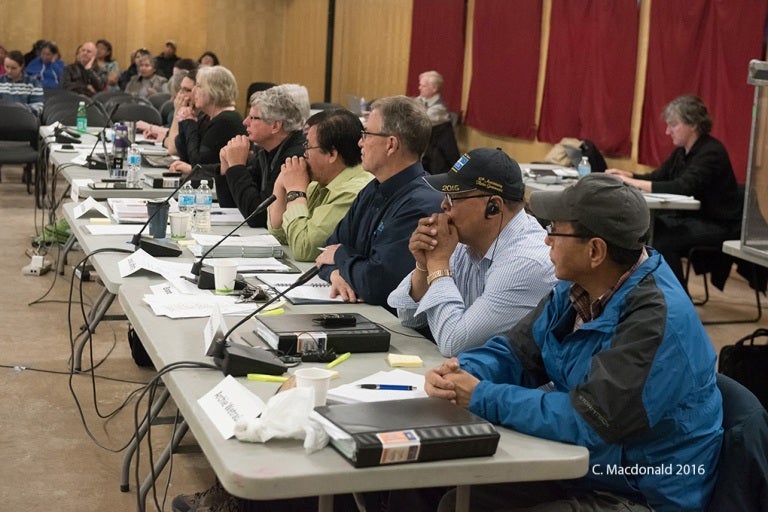
WRRB Board Members, from bottom right: Archie Wetrade, Charlie Jeremick'ca, Grant Pryznyk (Chair), Jonas Lafferty, and Steve Matthews. To their left: John Donihee, Legal Counsel; Allice Legat, Traditional Knowledge Advisor; Boyan Tracz, WRRB Wildlife Management Biologist. (Photo courtesy of Colin Macdonald)
Bluenose-East Caribou Proceeding:
In December 2015, the Tłı̨chǫ Government and ENR submitted the Joint Proposal on Management Actions for Bluenose-East Caribou 2016-2019 to the Board. It proposed new restrictions on hunter harvest, predator management and ongoing biological monitoring. It also proposed implementing a total allowable harvest (TAH) and allocation for the herd and conducting a feasibility assessment of a full range of wolf management actions.
The Board held a public hearing in Behchokǫ̀ on April 6-8, 2016. At the hearing, the Board heard evidence from the Tłı̨chǫ Government and ENR, and from the two intervenors in the proceeding, Déline First Nation and the North Slave Métis Alliance. The Board also heard from members of the public. The transcripts for the hearing can be viewed on the Board’s Public Registry at http://wrrb.ca/public-information/public-registry
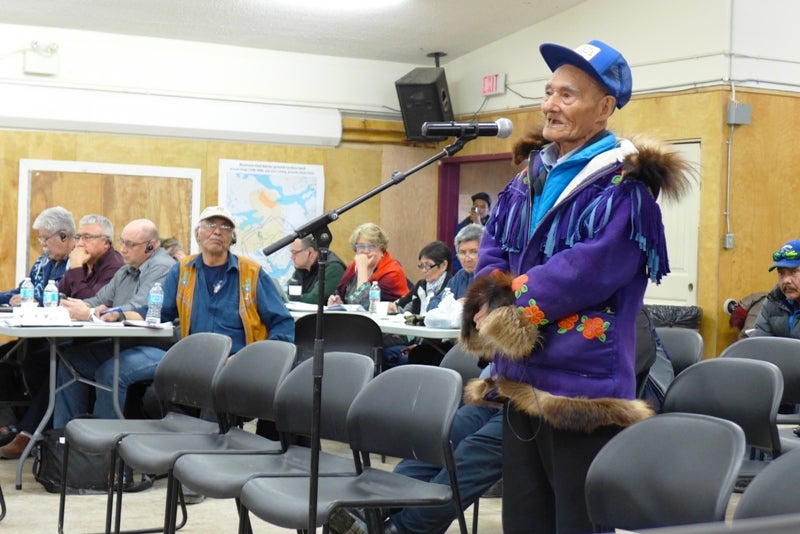
Members of the public shared their comments at the Public Hearings. (Photo: Susan Beaumont, WRRB)
The WRRB reviewed traditional knowledge and scientific information related to barren-ground caribou and, in particular, the Bluenose-East caribou herd as well as other topics related to the proposed management actions before the Board. As part of its information-gathering and to help it make balanced decisions and recommendations, the Board held two technical sessions, a Science Technical Session on March 17, 2016 and a Traditional Knowledge Technical Session held on March 22, 2016. The technical sessions were based on issues that required clarity or further discussion prior to the Public Hearing. Summaries of both sessions are posted on the Public Registry.
After careful review of the evidence and information on the public record, the WRRB submitted its Final Reasons for Decision Report, Part A, to the Tłı̨chǫ Government and GNWT on June 13, 2016. The Board concluded that a serious conservation concern exists for the Bluenose-East caribou, based on the steep decline in population, as well as an accelerated decline in the number of breeding females since 2013. In its report, the Board also noted that vital rates associated with the herd are low. These include cow pregnancy, calf recruitment (the number of calves surviving to a year in age and are “recruited” into the herd), and cow survival—important indicators of population trend (whether the population is increasing, decreasing or stable).
The Board determined that a TAH of 750 bulls be implemented for all users of the Bluenose-East caribou in Wek’èezhìı. It also determined a proportional allocation of the TAH of 39.29% for Tłı̨chǫ Citizens and 60.71% for members of an Aboriginal people who traditionally harvest Bluenose-East caribou.
The Board also recommended compliance monitoring by community monitors and wildlife officers with regular harvest updates, as well as increased communications and public education programs. In addition, the Board recommended the development of a collaborative feasibility assessment of options for wolf management, led by the WRRB with input and support from the Tłı̨chǫ Government and GNWT.
Part B of the Reasons for Decision report will be submitted in August 2016 and will address additional predator management actions, biological and environmental monitoring, and cumulative effects.
Fact Box--Bluenose-East Caribou Herd Management:
- Prior to the 2016 proceeding, the Board conducted a proceeding to address Bluenose-East caribou harvest limitations in 2010. The Bluenose-East caribou herd has continued a declining trend in population since 2009.
- The Board participates in long-term management planning processes for the Bluenose caribou herds with the Advisory Committee for Cooperation on Wildlife Management (ACCWM). The ACCWM developed the “Taking Care of Caribou: the Cape Bathurst, Bluenose-West, and the Bluenose-East Barren-ground Caribou Herds Management Plan” to address caribou long-term management and stewardship of these herds. That plan is being used to complete specific Action Plans for each of the Bluenose herds, including the Bluenose-East caribou herds.
- The Board has submitted comments to both the Nunavut Planning Commission and the Nunavut Impact Review Board related to the Bluenose-East caribou herd. It provided its view that the calving and post-calving grounds should have no exploration or development on them at any time, as they are of vital importance for caribou.
WRRB Presentations at the Nunavut Wildlife Management Board’s public hearing
To share information, Jonas Lafferty, Board member, and Jody Pellissey, Executive Director, participated in public hearings for the Bathurst caribou herd and for the Bluenose-East caribou herd that the Nunavut Wildlife Management Board (NWMB) held in Cambridge Bay on June 14-17, 2016.Because the Bathurst caribou and the Bluenose-East caribou herds are migratory species that move between the NWT and Nunavut, the WRRB requested an opportunity to present the evidence collected in its own proceedings for the two barren-ground caribou herds to the NWMB for consideration.
In its presentations, the Board stressed the importance for all users and managers of these herds to act now to protect the caribou so future recovery may be possible and urged the NWMB to take a similar approach to the protection of the Bathurst and Bluenose-East caribou in Nunavut.
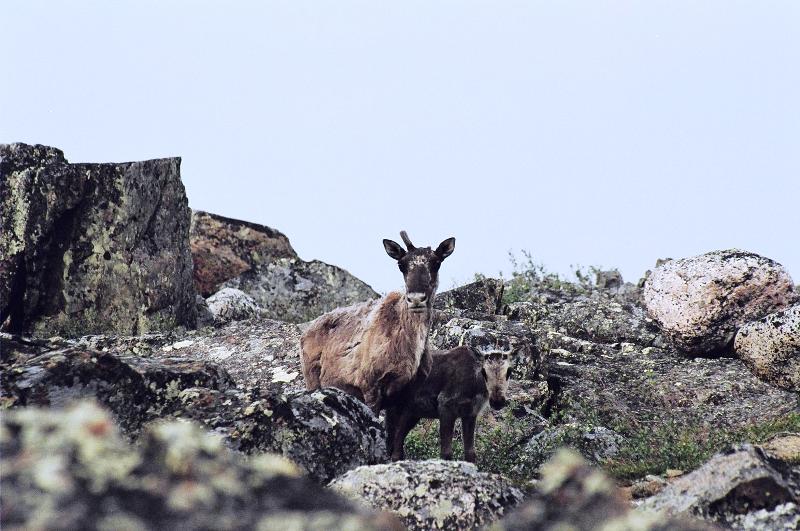 Bathurst cow and calf. GNWT / Anne Gunn
Fact Box: Bathurst and Bluenose-East Caribou Herds
- The Bathurst caribou is named for Bathurst Inlet, Nunavut, the general area of the herd’s traditional calving grounds.
- The Bluenose-East caribou’s calving grounds are west of Kugluktuk and fall almost entirely on the Nunavut side of the border.
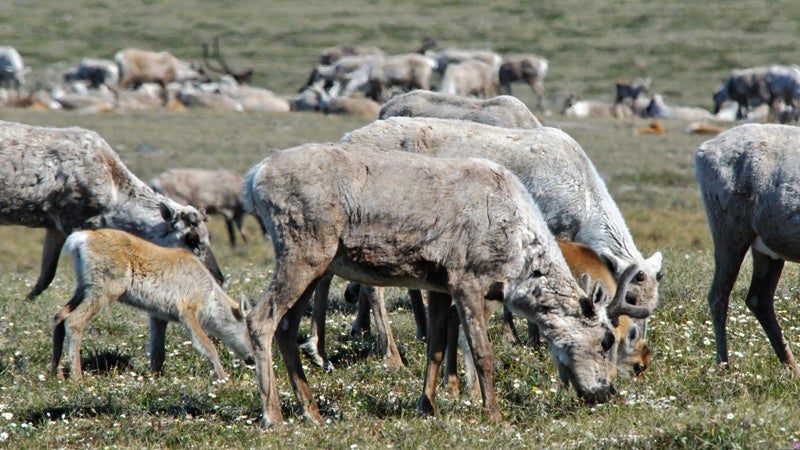 Bluenose-East Caribou, GNWT / Boyan Tracz