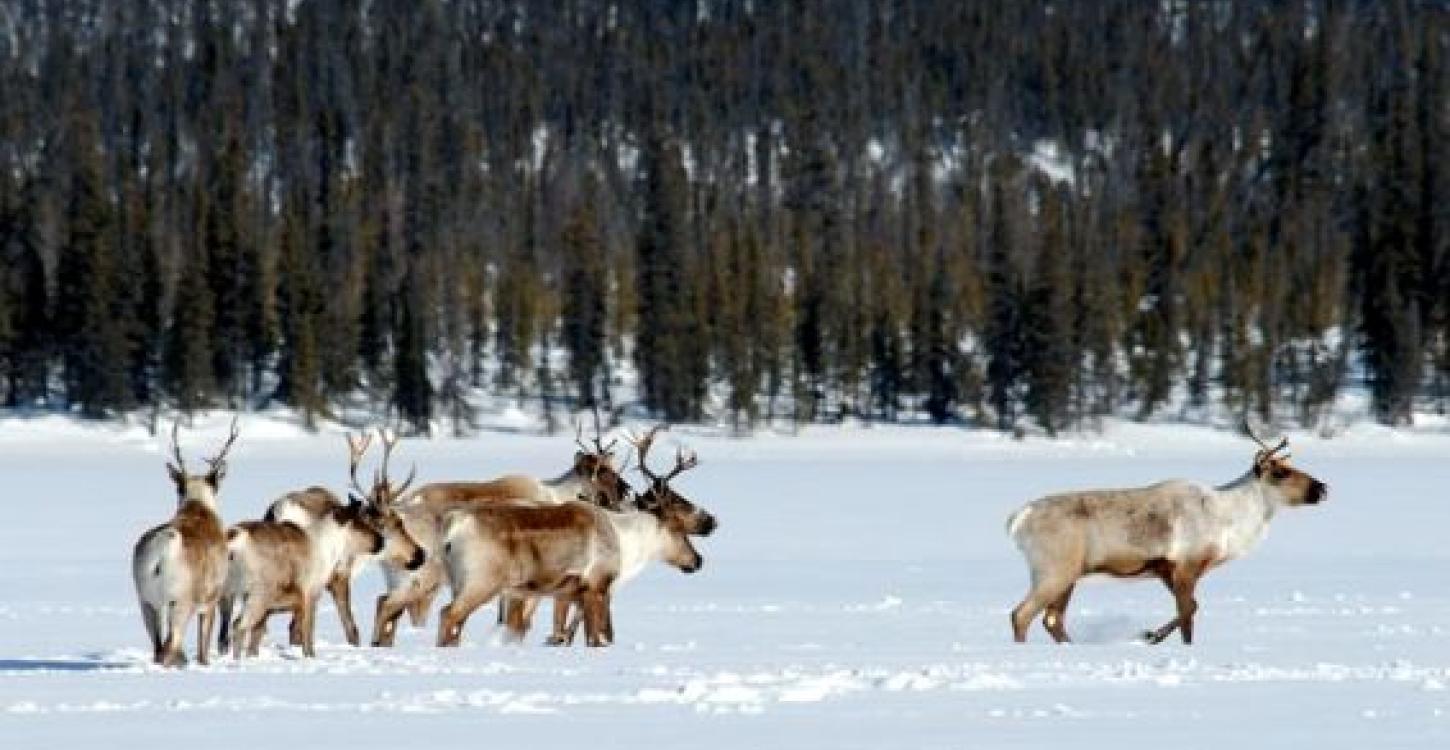
Habitat is important for all wildlife –and critically so for boreal woodland caribou (tǫdzı in Tłı̨chǫ).
In many parts of Canada, their homes in the boreal forest have been under threat. Boreal caribou need large undisturbed areas to thrive, but in some cases, particularly in southern Canada, their habitat has been fragmented or reduced, even lost. Boreal caribou in Canada are nationally listed as threatened under the federal Species at Risk Act. Recently they were assessed as threatened in the NWT and are currently being considered for listing under the NWT List of Species at Risk. There are concerns that with development, climate change and other potential risks to caribou habitat, tǫdzı here could be a greater risk in the future.
In 2011, the WRRB and the Tłı̨chǫ Government began a research project to learn more about boreal caribou habitat and habitat use in Wek’èezhı̀ı conducting traditional Tłı̨chǫ knowledge research and collecting existing scientific data. There are many questions. Do the caribou have enough undisturbed vegetation and old growth forest to forage --and enough space to spread out to avoid predators? Which areas do the caribou prefer –and at what times of the year? Which areas are used for browsing? For calving and raising young? How do forest fires affect their movements and distribution? We need to know as much as we can about the state of their habitat and about the secretive tǫdzı themselves in order to ensure their habitat requirements are met.
One of the recommendations from the 2011 Report was for more in-depth science and traditional knowledge research examining areas where there have been forest fires, whether and how tǫdzı have used those areas, and how burned areas regenerate back to areas of preferred habitat.
The project was carried out using a parallel process--collecting both traditional and scientific knowledge--and in this way, gathering the greatest amount of information.
Tłı̨chǫ Knowledge Research Camp 2012
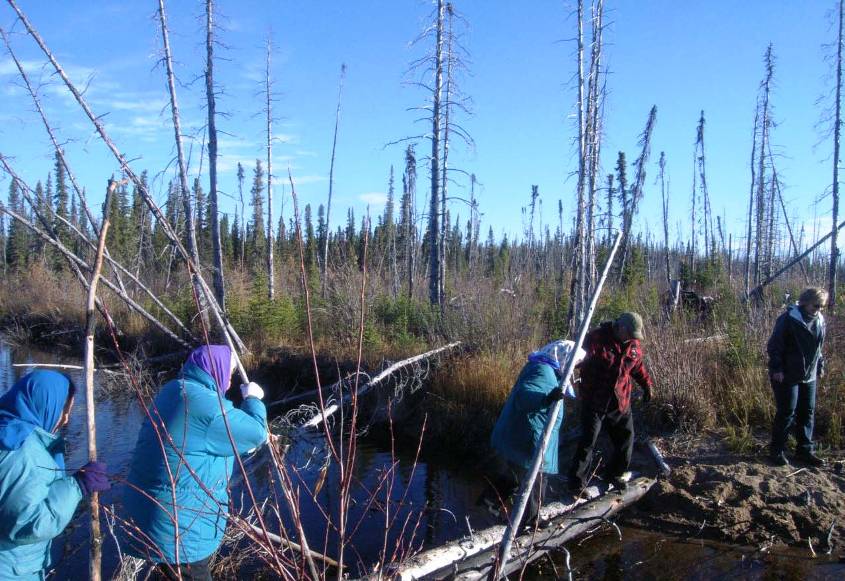
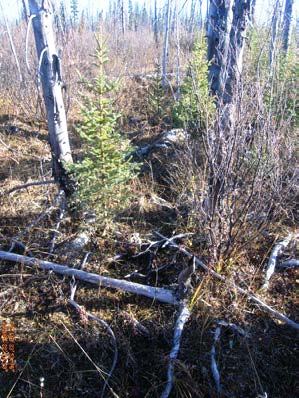
For the traditional knowledge research in 2012-2013, six Tłı̨chǫ elders from Behchokǫ̀ and Whatì selected Ɂedèezhı̀ı̀ (Horn Plateau) as the study area. Ɂedèezhı̀ı̀ is a place of historical and cultural importance to the Tłı̨chǫ and Dehcho people. Its abundant wildlife sustained people in times of need. In 1995, an intense fire burned much of the area. The elders decided to observe the state of tǫdzı habitat and the re-growth that has taken place since the fire—and to collect information to help answer questions such as when do tǫdzı return to a burn area? When is the bush thick enough for them to be camouflaged? When can they forage again?
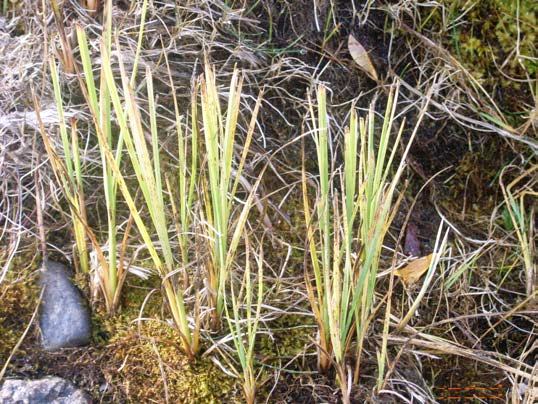
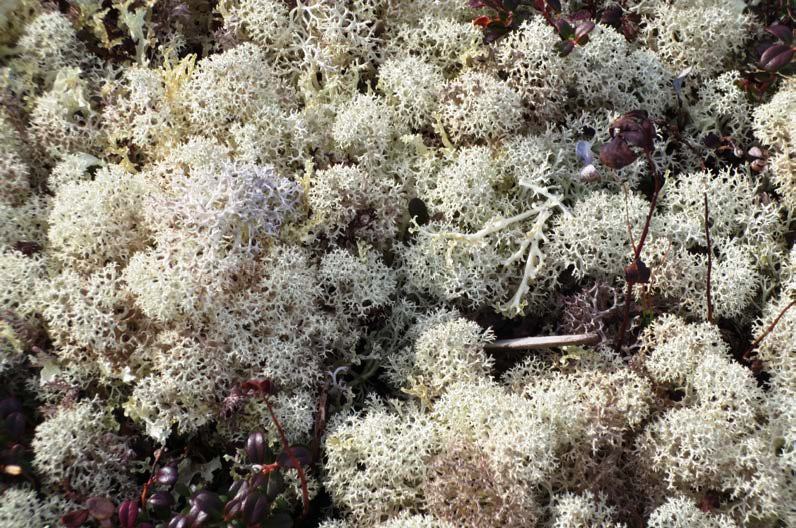
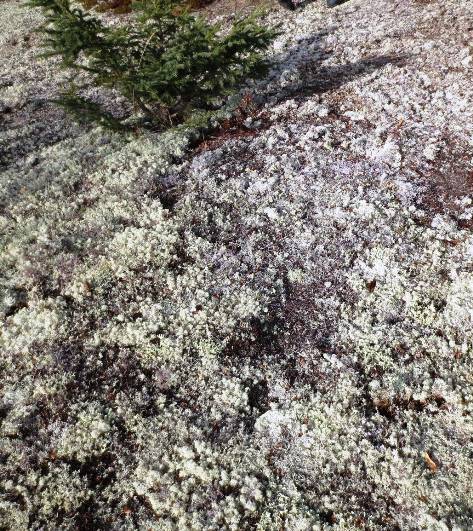
The research team, working with consultant Allice Legat and Rita Wetrade, Tłı̨chǫ Knowledge Coordinator, Tłı̨chǫ Government, spent seven days on the land last September 24-30, 2012. They looked for signs of tǫdzı and other wildlife and examined vegetation to determine the health of berry bushes, lichen, trees and grasses.
During their field research, the elders documented specific places preferred by tǫdzı. Tsoo (waterlogged soil, bogs, thick vegetation) provides tǫdzı with cover to hide from predators and with food to forage. Another habitat type, whagweè (sandy soil mixed with black dirt) provides tǫdzı with hard ground where they can travel quickly without twisting their legs or harming their hooves. Researchers observed that there were still pockets of healthy tsoo and whagweè and that small stands of vegetation important for tǫdzı were untouched.
Evidence of tǫdzı was present throughout the area. There were also signs of moose and predators. The team’s observations suggest that tǫdzı can survive with some loss of their forest habitat by using areas less severely burned or by moving to different areas. However, researchers also observed that forest fire disturbances to nǫdı̀ı (taiga plain) have led to fewer tǫdzı in the area.
Scientific Analysis
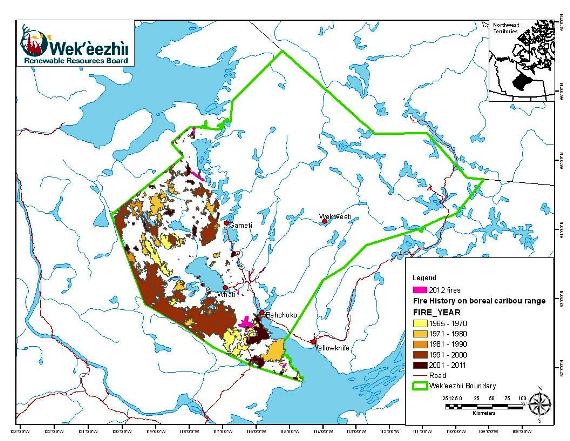
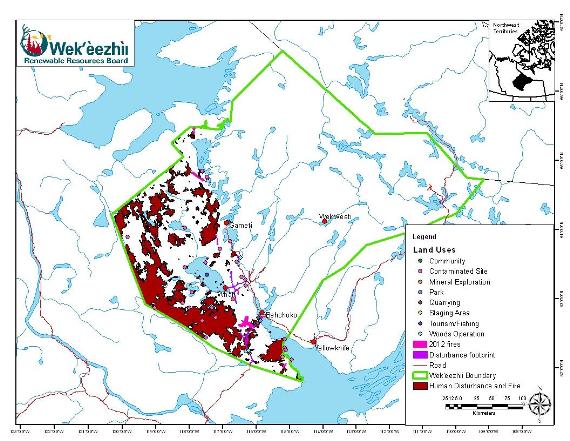
The scientific data collected showed that overall, an estimated 33.4% of tǫdzı (boreal caribou) habitat within Wek’èezhı̀ı has been disturbed, either by forest fires or by human activity. Forest fires account for most of that disturbance—32.8% of the tǫdzı’s habitat has been disturbed by fire within the last 40 years. Based on a previous analysis (2011), there is relatively little disturbance resulting from human activity—less than 1%. However, updated data showing the spatial extent of human induced disturbance was not available for 2012.
The federal Recovery Strategy for the Woodland Caribou, Boreal population in Canada requires 65% --almost 2/3--of boreal caribou habitat within the range of a local population to be undisturbed. This means that for boreal caribou to thrive, no more than 35% of its habitat should be disturbed by natural processes such as fire or by human activities such as roads or seismic lines. At 33.4%, we’re getting close to the 35% mark, and further disturbance could put tǫdzı populations in Wek’èezhı̀ı in jeopardy.
Where do We Go From Here?
Both the research done in the field by the Tłı̨chǫ Research team and the scientific data suggest that the main threats to tǫdzı are disturbances to its habitat. Much of their habitat in Wek’èezhı̀ı is still relatively intact. There is still a large amount of secure, unburned habitat within Wek’èezhı̀ı –and so far, very little human disturbance. Tǫdzı may continue to be resilient here and use the strategies they have used in the past to thrive. But further research is needed to more fully understand their abundance, distribution, and behavioural strategies -- and how all these might be influenced by further disturbance.
To build a more complete picture, the elders recommended that tǫdzı winter habitat and behaviour be researched in future, as well as tǫdzı use of islands. More in-depth traditional knowledge and science research is also needed to understand the relationship between predators and tǫdzı. And to manage tǫdzı range in Wek’èezhı̀ı within the 35% disturbance threshold, we will need to know as accurately as possible the total geographic area that has been disturbed each year. The extent of habitat disturbance resulting from forest fires is measured and mapped each year, but we also need to track on an annual basis how much area has been disturbed as a result of human activity.
View the Final Report 2012 here: Boreal Caribou Habitat and Disturbance in Wek’èezhı̀ı Report
Fact Box
- Tǫdzı range in Wek’èezhı̀ı largely coincides with the taiga plains ecosystem (nǫdı̀ı in Tłı̨chǫ).
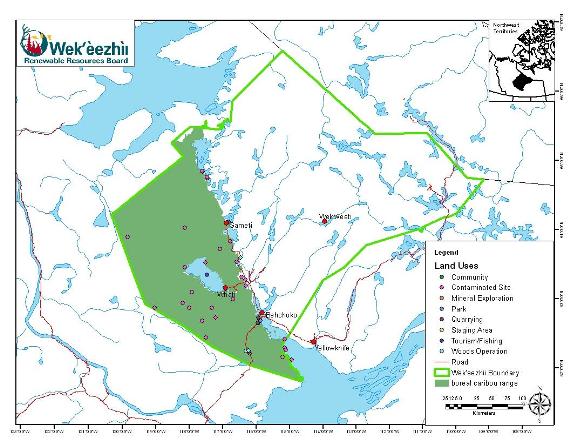
- Tǫdzı inhabit 31% of the total area of Wek’èezhı̀ı.
- Tǫdzı are found in small groups at naturally low densities. Within Wek’èezhı̀ı, the average density of boreal caribou within Wek’eezhii is 1.38 caribou for every 100 square kilometers. Using that estimate and the size of their range, researchers have calculated there are an estimated 650 boreal caribou in Wek’èezhı̀ı.
- If the decision is made to add Boreal Caribou (tǫdzı) to the NWT Species at Risk list, then a recovery strategy will be developed to help address threats to habitat and ensure their future.
- As they are easily disturbed by the slightest changes in their boreal forest habitat, boreal caribou (tǫdzı) are considered an indicator species that can tell us about the health of the boreal forest.