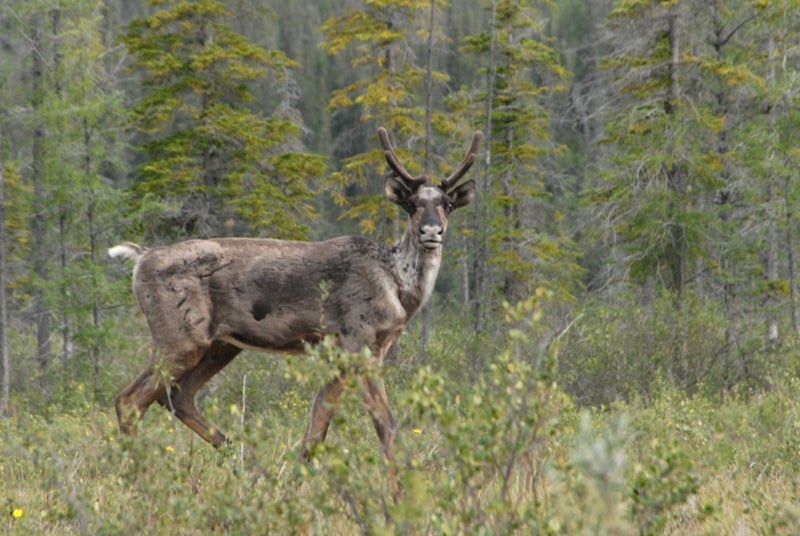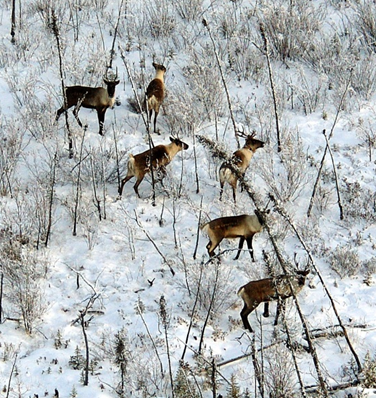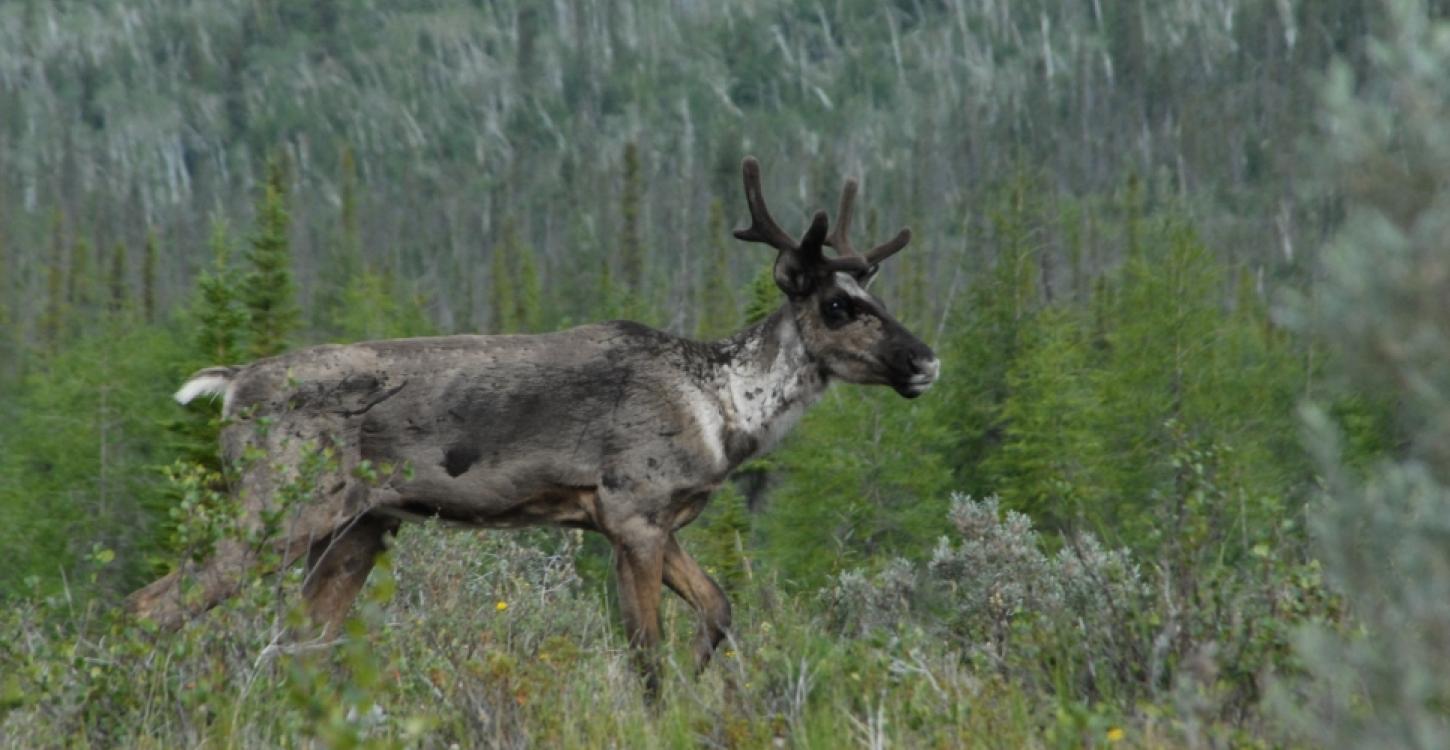
The WRRB has responsibility for all wildlife in Wek’èezhı̀ı, including species at risk. In 2012, the NWT Species at Risk Committee assessed Boreal Caribou as Threatened in the Northwest Territories (NWT) primarily because habitat fragmentation in the NWT is expected to increase in the future due to increased oil, gas and coal exploration activities, commercial uses of the forest, and forest fires. These factors, along with potential climate change-related impacts, are expected to result in a continuing decline in secure habitat and the number of boreal caribou – leading to concern that Boreal Caribou could disappear from the NWT in our children’s lifetime. Recently, Boreal Caribou were officially listed as a threatened species in the NWT under the Species at Risk (NWT) Act.
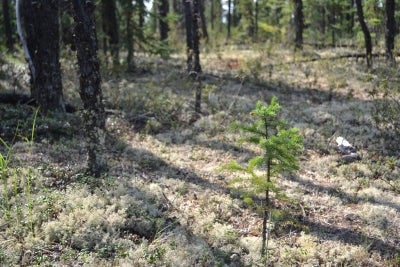
Fragmentation of habitat occurs when a habitat is disturbed and broken into smaller, isolated patches. Building a road through a forest is an example of habitat fragmentation. When fragmentation happens, a species loses its continuous range.
Listing Boreal Caribou as threatened means that a recovery strategy will be developed to help address threats to these caribou and ensure their future. For more information about Boreal Caribou or the listing process see the Species at Risk Fact Sheet on Boreal Caribou and visit the NWT Species at Risk website.
To date, research on the boreal caribou in Wek’èezhı̀ı has been fairly limited. To learn more about Boreal Caribou (tǫdzı) in Wek’èezhı̀ı, in 2011, the WRRB and Tłı̨chǫ Government began a study to bring together ecological information on boreal woodland caribou through focused traditional knowledge research and the gathering of existing scientific data that were collected previously. The scientific data showed that overall, an estimated 33.4% of tǫdzı habitat within Wek’èezhı̀ı has been disturbed, primarily due to fire but also including human activity. This is very close to a threshold set by the federal Recovery Strategy for Boreal Caribou, which requires that no more than 35% of boreal caribou habitat be disturbed in order to recover or maintain self-sustaining populations. Read more about this study.
A self-sustaining wildlife population is able to maintain its natural population levels without human intervention.
We hope to continue to learn more about the boreal caribou’s ecology, including its habitat use in Wek’èezhı̀ı, through future projects. Building on the existing traditional and scientific knowledge will assist the WRRB and its wildlife management partners in the effective management and protection of boreal caribou in Wek’èezhı̀ı.
Fact Box
- There is a federal Species at Risk Act (SARA) and a territorial Species at Risk Act (NWT).
- These Acts are separate but complement each other. Each has a committee of experts that assesses which wildlife species either in Canada (under SARA) or in the NWT [under the Species at Risk Act (NWT)] are at risk.
- Boreal Caribou in Canada are nationally listed as Threatened under the federal Species at Risk Act.
- Boreal Caribou in the NWT are listed as Threatened under the Species at Risk Act (NWT).
- Following consultations in Tłı̨chǫ communities in August, the WRRB decided at its September 2013 Board meeting to support the proposed listing of Boreal Caribou under the NWT Species at Risk Act, and brought its recommendation to the Conference of Management Authorities (CMA) at its meeting in October. At this meeting, the CMA decided by consensus to list Boreal Caribou as a species at risk in the NWT.