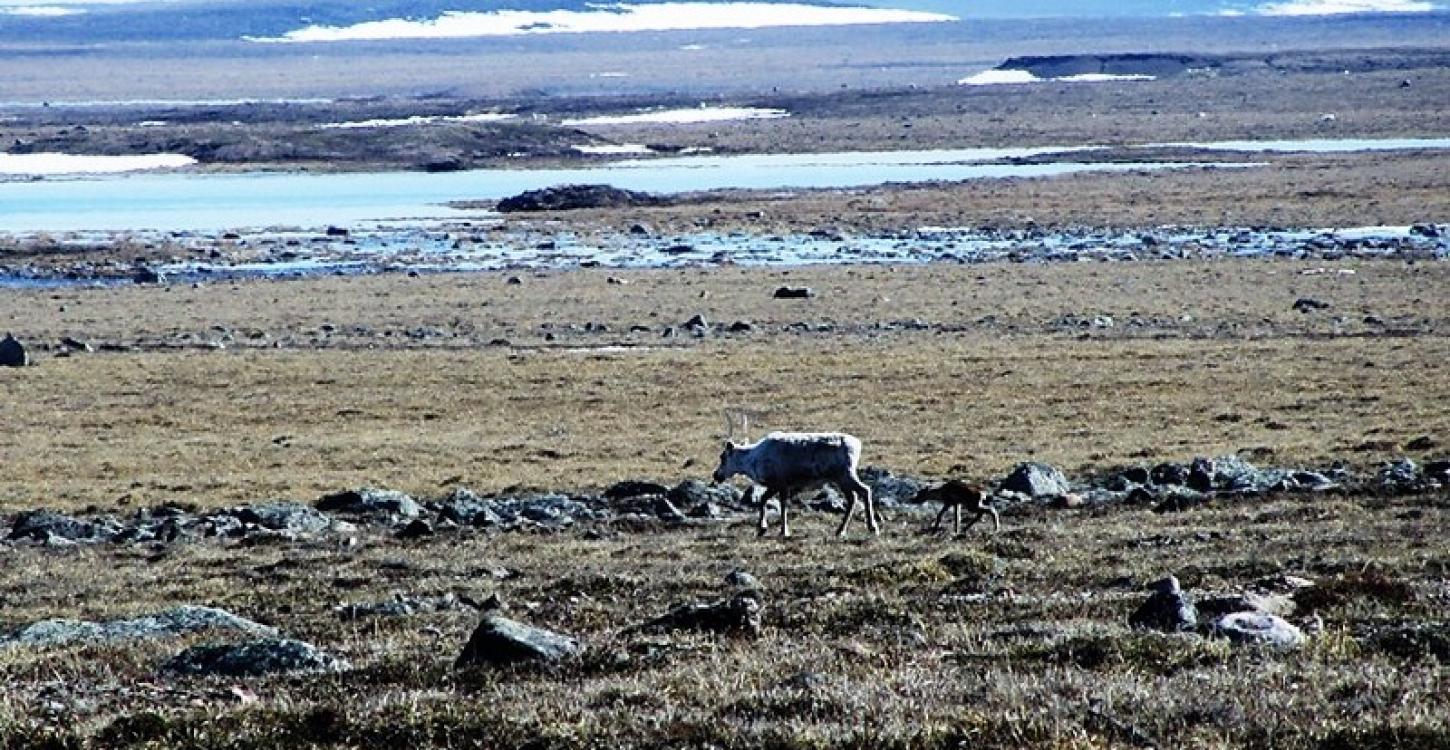
Population surveys for the Bathurst and Bluenose-East caribou herds are planned for this June 2018. Once completed, the results will give new population estimates for the herds.
Population surveys are done at times in the annual life cycle when large numbers of caribou gather together, such as each year’s calving in June. At that time, there are mostly breeding cows on the calving grounds along with a few bulls, yearlings or non-breeding females. Photo surveys are conducted every three years and are used to estimate the number of breeding cows in the herd. Community members and biologists act as observers on these aerial surveys.
The first step in the survey is a fly over –or a reconnaissance flight--to define the boundaries of the area to be surveyed. Where the caribou are in greatest numbers and grouped closely together, it is too difficult to count them visually, so they are photographed by a small, specially designed aircraft. Where the caribou are fewer in number and more spread out, another plane is used where observers on either side of the plane count all the caribou within a set area.
Following the flying of transects, a composition survey is conducted on the calving ground where caribou are classified as calves, yearlings and cows – breeders / non-breeders to adjust the total caribou counted on the calving ground to reflect the number of breeding females. Usually, the cow-calf groups take up most of the calving ground while bulls, yearlings, and non-breeding cows are often on the edges and to the south of the main calving area.
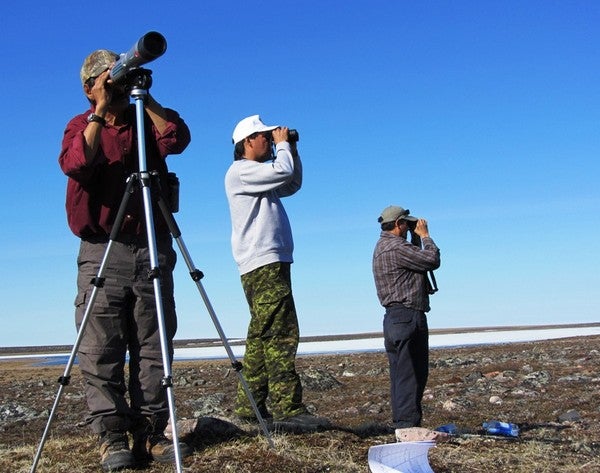
(Photo: Conducting a composition survey on the ground / WRRB)

(Photo: Yearlings on the calving ground / WRRB)
The calving ground survey gives researchers a good picture of how many breeding females there are but an estimate for the entire herd has to include adult male caribou. As there are few bulls found on the calving grounds they cannot be counted at this time. A composition survey is done either the following fall or in the fall previous where the number of bulls and cows is counted and a bull to cow ratio is calculated. From that ratio, the number of bulls can be estimated for the herd and added to the number of breeding cows counted on the calving ground. Comparing this new estimate with previous estimates will determine whether the population trend is stable, decreasing, or increasing.
What happens next?
Counting caribou is a time-consuming task –both on the aerial surveys and afterwards in the lab where thousands of photos have to be examined. Caribou from the June surveys will be counted –and the composition survey work will be conducted this fall to arrive at final population estimates for the Bathurst and Bluenose-East caribou herds. Those population estimates will then be available before the end of 2018.
Fact Box
- In addition to the photo surveys on the calving grounds, spring “recruitment” surveys and fall composition surveys are also two important indicators of caribou herd health.
- The late winter calf survival survey (spring recruitment survey) provides a measure of calf survival as they reach 9 months of age and an index of recruitment for the herd (i.e. how many new caribou are recruited and added to the population). Normally, this survey is conducted in late March or early April every year to provide a long-term trend assessment of herd productivity (how many young are produced).
- The fall survey is conducted during the rut (mid-October) and is designed to assess the ratio of bulls to cows in the herd. Usually a herd in decline and / or at a low number will have a low sex ratio (i.e. fewer bulls to cows). The sex ratio is needed to extrapolate the total population estimate when a calving ground photo survey is conducted.