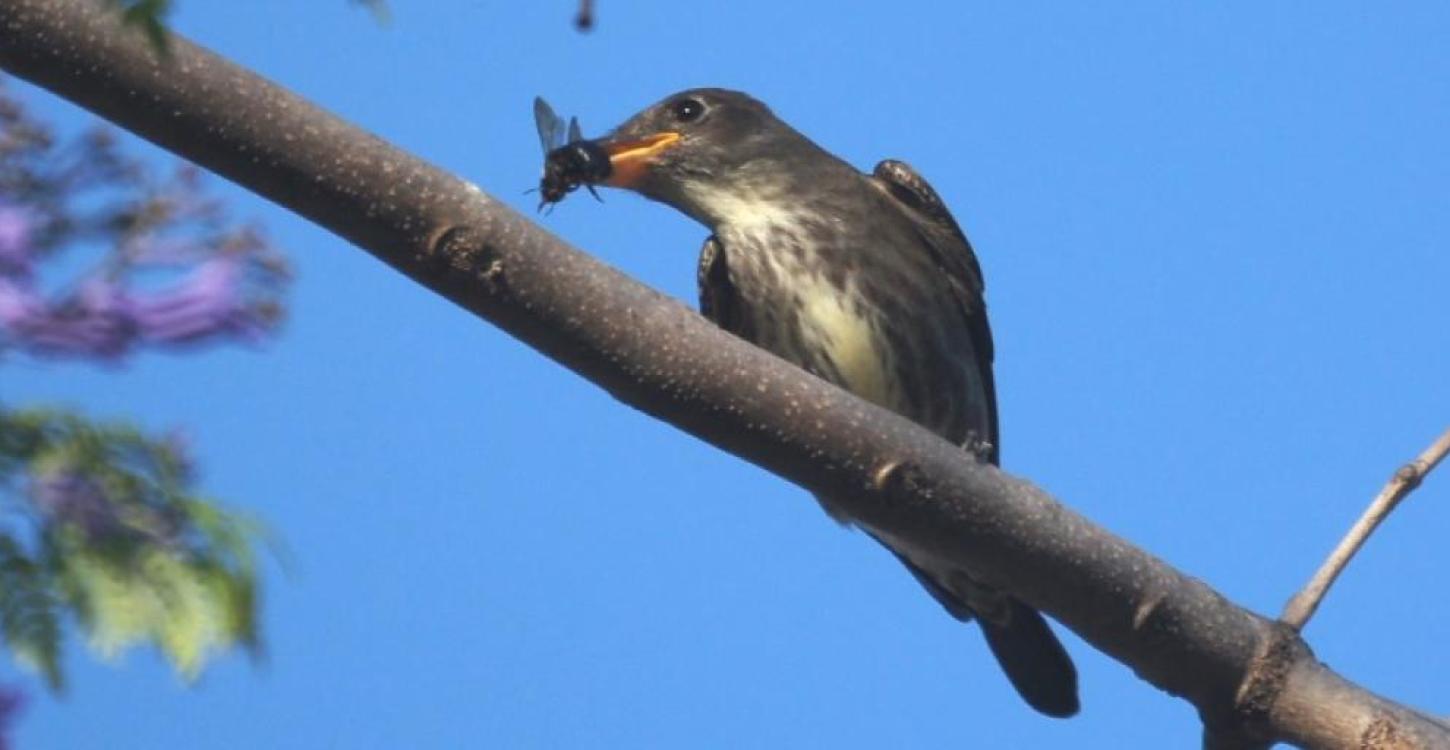
Nature is full of sounds, and scientists are listening in to bird song and calls to learn more about landbirds and their summer habitat here in the North. A research team, led by Samuel Haché, Canadian Wildlife Service, is using sound recordings and field observations to monitor the effects of natural disturbances—and forest fires in particular—on landbirds. How does recent fire affect the types and numbers of birds that are present, and how do bird communities change as the forest regenerates after fire?
The team set out song meters (wildlife audio recorders) to record bird songs at locations in burned and unburned areas in February 2016 along the Tibbett to Conwoyto winter road and again, early in May along Highway 3 between Fort Providence and Behchokǫ̀ before migratory birds arrive in the spring. The study sites included areas that burned in 2014 and 2015, older burned forest near Behchokǫ, and unburned forest surrounding the burned study sites. The Natural Disturbance Long-term Monitoring Program started last June – July, 2015 with a pilot field season. This year, the team is collecting a second year of data –information that will allow researchers to detect which bird species are present and to estimate their population sizes. Researchers will then be able to compare the information they collect from the areas that burned in 2014 and 2015 with those from surrounding undisturbed forests and older burned areas.
Many bird species are declining across the country including some species that prefer forest burnt by fire, like the Olive-sided Flycatcher. The program will help researchers learn more about this species at risk and the quality of its breeding habitat in the northern boreal forest. They’re looking at how abundant food and predators are, the kinds and arrangement of trees and vegetation at each study site, how the birds use their territories, and how successful they are at finding mates and producing young. Migratory birds, like the Olive-sided Flycatcher, breed in the NWT but spend winter in southern regions. The team is using some interesting techniques and technology to document their migratory routes and wintering grounds and to learn more about these birds in all parts of their yearly cycle. We’ll tell you more about how the team is using a few sample feathers and tiny tracking devices when we follow up with the study in our next issue!