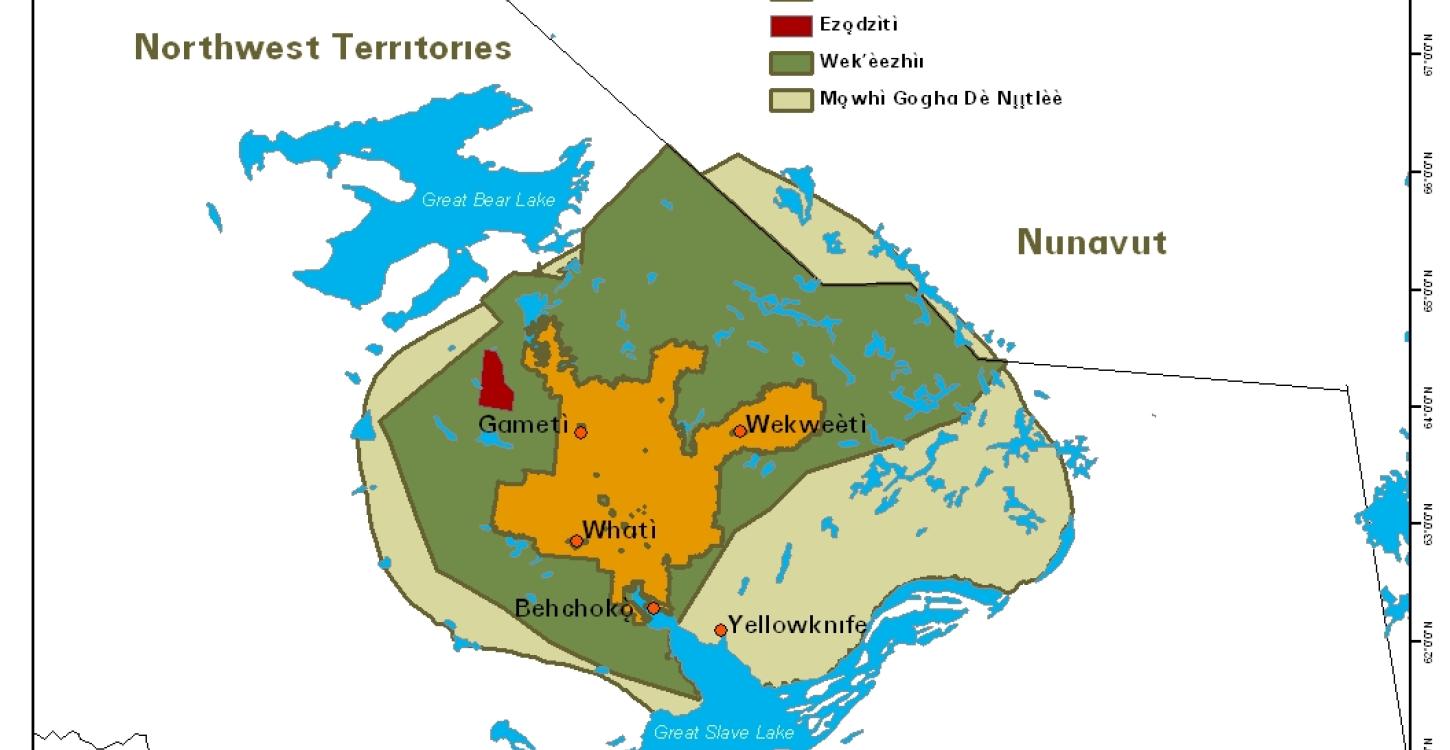
Welcome to the first issue of our e-newsletter, Points of Land. Notes from the Wek’èezhìı Renewable Resources Board! We’re excited about letting you know about our work and our involvement with various wildlife issues and projects. Reflecting our mission to manage wildlife and wildlife habitat in Wek’èezhìı (see map above),our logo represents the environment and the inter-connection of its living things: its animals, birds, fish, forests and plants. These interrelationships are key to how the Board does its work, balancing the needs of wildlife with the needs of those who depend on wildlife.
Working with other Government agencies,Tłįcho (Tlicho) communities and others with an interest in Wek’èezhìı, the Board manages Wek’èezhìı’s natural resources on behalf of Tłįcho citizens and the general public. A relatively young Board, the WRRB was created under the Tłįcho Agreement. Its members are appointed by the Tłįcho, territorial and federal governments, each bringing valuable knowledge and experience to the table when the Board makes its recommendations or decisions. The Board is guided by its vision that animal population and habitat can withstand change and use today and into the future.
In its deliberations, the Board uses the best information available, consulting traditional Tłįcho knowledge, science and expert opinion. Like points of land canoeists use as a reference point to paddle towards when crossing a lake, this information helps the Board arrive at well-informed, balanced decisions.
In this issue, we go from tundra to watershed and from bison to boreal caribou, describing the activities that the Board has been involved in over the past few months. We take a look at some of the research projects on the go –developing a homegrown, community-based fish and fish habitat monitoring program and collaborating with the Tłįcho Government on understanding more about the elusive boreal caribou from a Tłįcho as well as from a scientific perspective. We revisit summer by joining Karin Clark, the WRRB’s Wildlife Management Biologist, at a science camp up on the barren lands; and we take a look at how an aerial caribou calving ground survey is done as Board members engage in a mock survey exercise.
We hope you enjoy our newsletter. Let us know what you think or if you have any story ideas for a future issue. We welcome photo submissions that will help us tell our story.
We’re also working on updating our website over the next couple of months so watch for that too. You will be able to subscribe to our newsletter by visiting the WRRB website at www.wrrb.ca