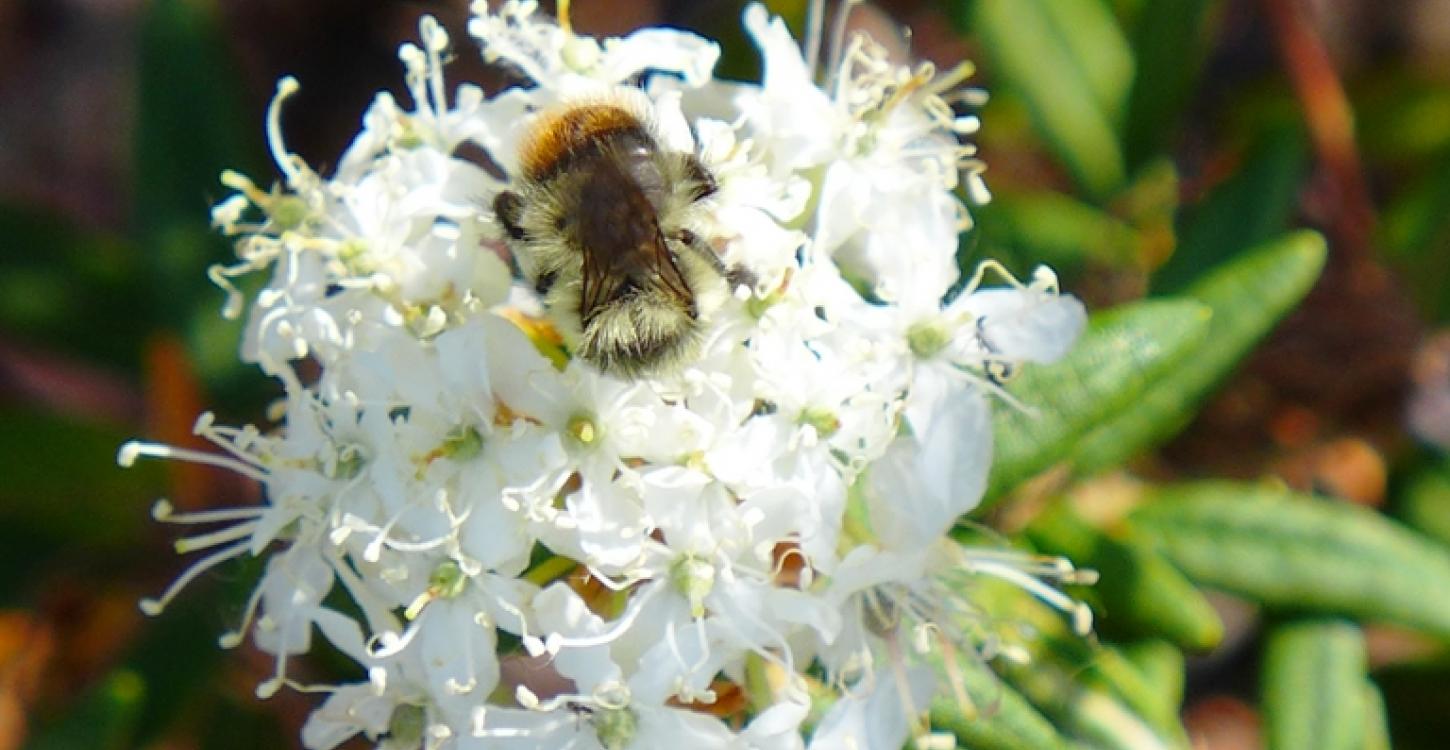
Bumblebees are essential pollinators of agricultural crops and native plant species, such as fireweed and members of the rose family, such as cranberries and raspberries. Pollination allows plants to produce seeds and grow, providing food and shelter for many animal species.
Bumblebees are able to fly in cooler temperatures and lower light levels than many other bees—characteristics that make them well suited to the conditions in the northern parts of their range. When most insects are inactive due to cold temperatures, bumblebees are able to fly by warming their flight muscles by shivering, enabling them to raise their body temperature. This way, they are doing their job earlier in the season, earlier and later in the day, on both cloudy and sunny days.
But scientists are finding that many previously common bumblebees, including the Yellow-banded Bumblebee, are declining in southern locations where they were once common. In the NWT, there are three bumblebee species that have been assessed nationally as species of risk. Two of those species, the Yellow-banded Bumblebee and the Gypsy Cuckoo Bumblebee, occur in Wek’èezhìı.
If you’d like to help monitor bee populations, you can send observations, questions or pictures of bees to NWTbugs@gov.nt.ca
Fact Box
- There are about 250 species of bumblebees globally; twenty-one species of bumblebees occur in the NWT.
- Bumblebees use “buzz pollination” to collect pollen. A bee will grab the anther (the part of the flower that produces pollen) and vibrate its wings. The resulting vibrations dislodge the pollen from the flowers, helping plants produce more fruit. On average, they can visit anywhere from 12 to 21 flowers in a minute!
- Bumblebees are also strong flyers. Powered by contractions of the thorax, or midsection, the insects’ wings beat 130 or more times per second.
What is the Difference between Bumblebees and Honey Bees?
Although they are both bees, eat pollen from flowers and can sting, bumblebees and honeybees are also different in various ways. Here are a few key differences:
- Bumblebees, belonging to the genus Bombus, tend to be furry and rounded in shape. Honeybees, in the genus Apis, are smaller and more slender and wasp-like in appearance and typically have a stronger pattern of stripes.
- Honeybees have short tongues so they prefer open flowers. Bumblebees, on the other hand, have different lengths of tongue, depending on the species, and extract pollen from different shaped flowers.
- Honeybees are known for their complex hives and large colonies of up to 50,000-60,000 bees. Bumblebees live in nests in much smaller colonies of 50-400 bees.
- The queen is the only member of a bumblebee colony to overwinter and lives for a year; a honeybee queen and many of her daughters (worker bees) live in the hive all year, and the queen can live for 3-4 years.
- Unlike honeybees, bumblebees do not “dance” to communicate where to find a food source to other bumblebee foragers. However, they may communicate by passing pollen between worker bees.