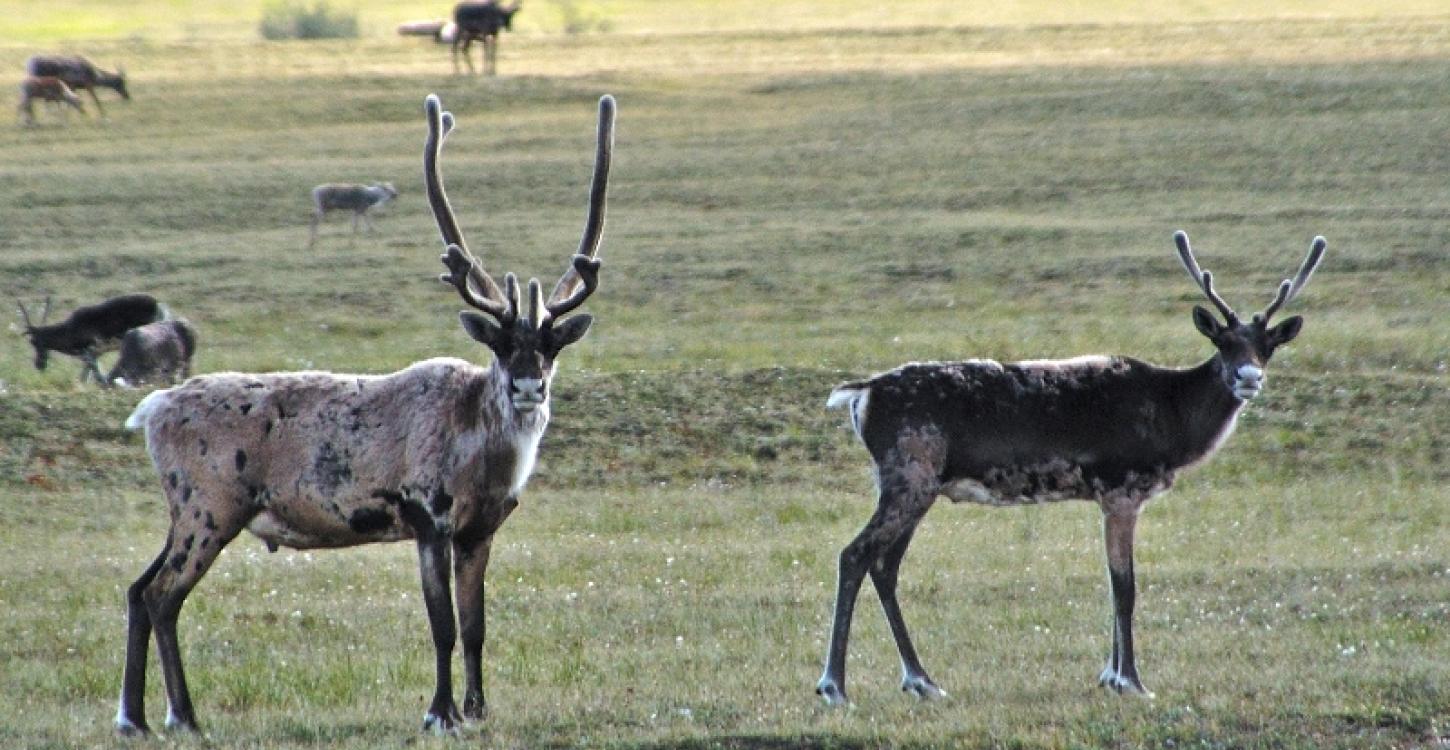
YELLOWKNIFE (June 13, 2016) – The Wek’èezhìı Renewable Resources Board (WRRB) submitted its Reasons for Decision report, Part A, on the management of the Bluenose-East caribou herd for 2016 to 2019 to the Tłı̨chǫ Government and the Department of Environment and Natural Resources (ENR), Government of the Northwest Territories today.
The report addresses management actions proposed by the Tłı̨chǫ Government and ENR in their Joint Proposal on Management Actions for Bluenose-East Caribou: 2016-2019, which was submitted to the Board in December 2015. The proposed management actions included new restrictions on harvesting of the Bluenose-East caribou herd, predator management, and ongoing biological and environmental monitoring.
The WRRB is responsible for wildlife management in Wek’èezhìı and shares responsibility for managing and monitoring the Bluenose-East caribou herd. Based on available Aboriginal and scientific evidence, the WRRB concluded that a serious conservation concern exists for the Bluenose-East caribou, given a steep decline in population, along with an accelerated decline in the number of breeding females since 2013. Additionally, vital rates associated with the herd, including cow pregnancy rates, calf recruitment and cow survival rates are low. Therefore, the Board determined that a total allowable harvest of 750 bulls-only shall be implemented for all users of the Bluenose-east caribou herd within Wek’èezhìı for 2016 to 2019, effective July 1, 2016. The Board also determined that the proportional allocation of the total allowable harvest for the Bluenose-East caribou herd shall be 39.29% for Tłı̨chǫ Citizens and 60.71% for members of an Aboriginal people who traditionally harvest Bluenose-East caribou.
The Board also recommended compliance monitoring by community monitors and wildlife officers with weekly harvest updates, as well as increased communications and public education programs. In addition, the Board recommended that a collaborative feasibility assessment of options for wolf management, led by the WRRB, be developed.
Part B of the Reasons for Decision report will address additional predator management actions, biological and environmental monitoring, and cumulative effects, and will be submitted to the Tłı̨chǫ Government and ENR in August 2016.
Additional information on the WRRB’s Reasons for Decision report, Part A, can be found in the attached Backgrounder. The report is available on the Public Registry at http://wrrb.ca/public-information/public-registry
For more information, please contact:
Grant Pryznyk, Chair
Wek’èezhìı Renewable Resources Board
T: 867-873-5741