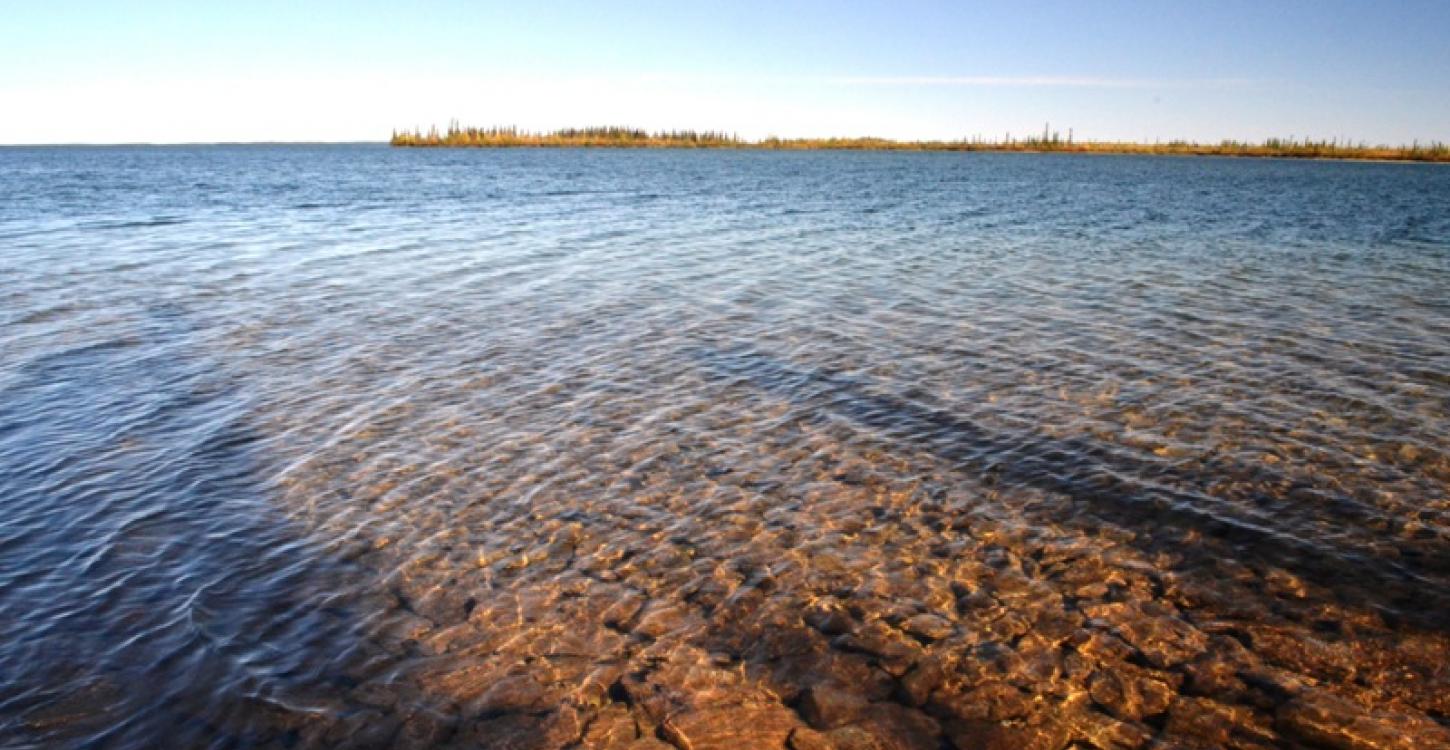
This year’s “fish camp” happens near Whatì during the week of September 8-12.
Boyan Tracz, WRRB’s Wildlife Management Biologist, travelled to Whatì in June to begin planning the camp with community members. To introduce the Tłı̨chǫ Aquatic Ecosystem Monitoring Program (TAEMP), Boyan showed community members a video that was made about last year’s fish camp in Gamètì. The video generated good discussion and input into where sampling could take place, as well as possible camp locations.
At a second planning meeting in August, Whatì community members met with Boyan, Sean Richardson, Wildlife Coordinator, Tłı̨chǫ Government; Shirley Beaverho, Community Director for Whatì; and Ted Nitsiza, Land and Resources Coordinator, Tłı̨chǫ Government. Participants put the finishing touches on the logistics for the fish camp’s location, timing and activities, and identified potential locations for fish and water sampling on a map of Lac la Martre. They also decided to concentrate the sampling on Lake Whitefish and Lake Trout.
The focus of the fish camp will be collecting fish, water and lake sediment samples for analysis later in a lab. But the on-the-land camp is also an opportunity to bring elders, youth and biologists together to learn from one another. It’s an ideal stage for an exchange of traditional Tłı̨chǫ knowledge and scientific knowledge—and for hands-on learning. The elders can share Tłı̨chǫ ways of understanding the aquatic ecosystem and assessing its health, as well as teach traditional ways of catching, preparing and preserving fish. The biologists and scientists can demonstrate standard scientific methods for collecting samples, data collection and “fish processing” –extracting fish tissue samples from the fish for testing later in a lab.
Look for our story on this year’s fish camp in our Fall Issue!
Fact Box:
- The TAEMP is a partnership that involves Tłı̨chǫ communities, the WRRB, the Tłı̨chǫ Government, the Wek’èezhìı Land and Water Board, and the Department of Fisheries and Oceans, with support from Golder Associates.
- The purpose of the TAEMP is to monitor the health of fish and fish habitats near Tłı̨chǫ communities, using both science and traditional knowledge.
- In the TAEMP, fish, water and lake bottom sediments near Tłı̨chǫ communities are sampled to develop a baseline or snapshot of environmental conditions that exist now. That baseline information gives a starting point against which it is possible to see if there are any changes in future. The plan in the TAEMP is to return to the same lakes four years later to repeat sampling and compare the new data with the baseline data. After this year’s fish camp, the TAEMP will have completed baseline sampling near all four Tłı̨chǫ communities.
- The overall approach for the TAEMP program is that each year, a fish monitoring camp is set up near a different Tłı̨chǫ community. So far, there have been camps on Marian Lake, Russell Lake, Snare Lake, and Rae Lakes. After this year’s fish camp near Whatì, the rotation through each community is planned to start up again.
- Lac la Martre known for its Lake Trout and Northern Pike, but the area is also rich in bird wildlife. Located along the North America north/south bird migration routes, its extensive marshlands are a haven for ducks, geese, and other migratory species that gather each spring and fall to feed.